

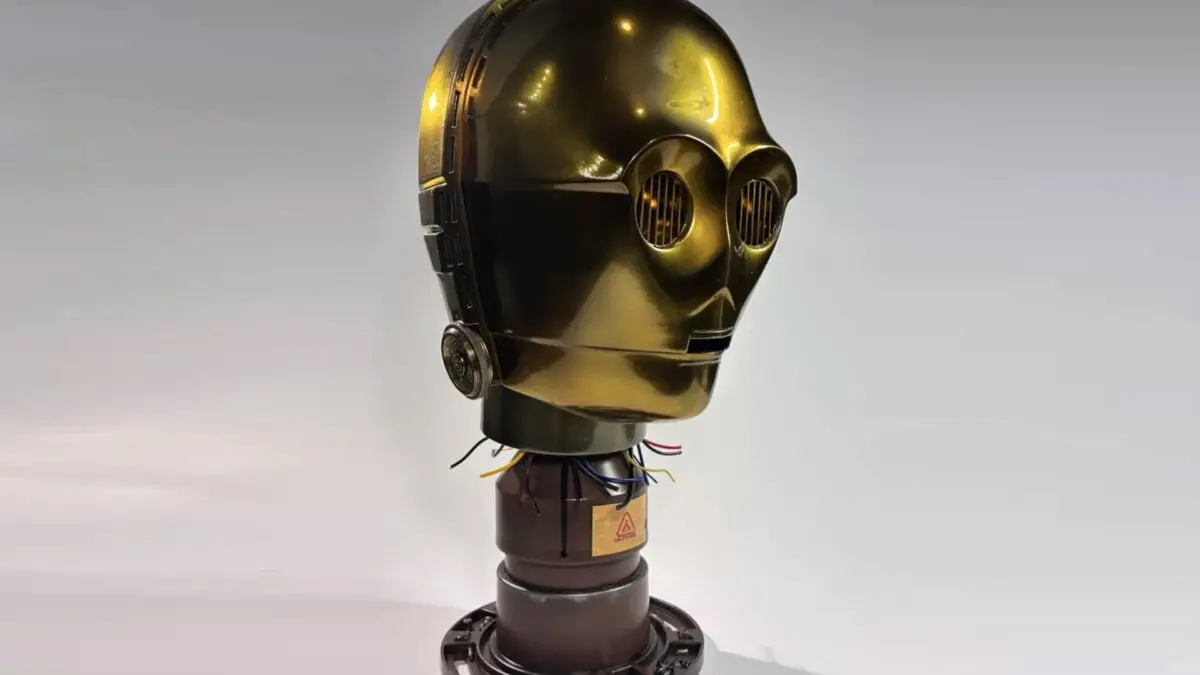
May the fourth be with you, and all that. For Star Wars Day, we celebrate one of the galaxy's most misunderstood characters: C-3PO, the golden protocol droid with the personality of a maître d’ who absolutely will not let you into the fancy restaurant. But now, thanks to a DIY project from a student at Chapman University, you can own a talking C-3PO head that brings the droid to life in ways never seen before—well, heard before.
Samuel Potozkin, a student in Orange County, California, recently shared a video and a detailed paper on GitHub that documents how he built a fully functional C-3PO head. The head not only looks the part but can hold a real-time conversation, powered by a custom large language model (LLM) specifically trained to emulate the prissy, verbose personality of Threepio. The result is a head that responds to your speech with bleeps, bloops, and perfectly delivered lines in that metallic, agitated tone we all know from the films.
The Technology Behind the Talk
The pipeline for this project is elegantly simple yet technically sophisticated. A microphone picks up your voice, which is fed into a Raspberry Pi 5—a tiny, affordable computer often used for embedded projects. The Raspberry Pi runs a real-time speech-to-text converter that transcribes your words into text. That text is then sent as a prompt to the LLM, which is fine-tuned to respond as C-3PO would. The LLM's output is converted back into speech using a text-to-speech (TTS) system that has been heavily modified to replicate the distinctive metallic resonance of the droid's voice.
Potozkin encountered a significant challenge during development: the initial TTS output didn't sound metallic enough. He describes in his paper that the raw audio lacked the “metallic vocal tone associated with C-3PO.” To achieve the desired effect, he applied a series of audio post-processing techniques that sound more like a guitarist's pedalboard than a typical robotics project. He introduced a short delay line to create tightly spaced temporal reflections, giving the voice a slight echo. Then he applied a chorus effect by slightly modulating the time and pitch of duplicated signal paths, creating the impression of layered vocal resonance. Finally, equalization (EQ) was used to boost certain frequencies while cutting others, mimicking the hiss and hum of the droid's physical vocalizer. The result is astonishingly authentic; even without seeing the head, listeners immediately recognize the voice as C-3PO.
The Mechanical Side
But the head isn't just a speaker in a box. Potozkin's design includes a fully painted, 3D-printed replica of C-3PO's head, complete with the iconic red eyes (though they don't light up in this version). The head is mounted on a simple stand, making it a perfect desk ornament or conversation piece. The electronic components—Raspberry Pi, microphone, speaker, and a small amplifier—are hidden inside a base module. The entire system is powered via USB, so it can be plugged into a computer or a portable battery pack. The project is open-source; all files, including the 3D printing STLs, the Python code, and the LLM training data, are available on Potozkin's GitHub page.
For those who want to build their own, Potozkin provides step-by-step instructions, including how to train the LLM on a dataset of C-3PO quotes from the Star Wars films. He notes that the model can be further fine-tuned with custom personality settings, so you can make your Threepio more or less sarcastic, or even adjust its vocabulary to include more of the character's signature phrases like “Oh my, what a terrible idea!” or “I suggest a new strategy, R2.”
The Cultural Significance of C-3PO
This project arrives at a time when Star Wars fans are more obsessed than ever with the droid who seems perpetually exasperated. C-3PO, along with R2-D2, has been a constant presence throughout the franchise, appearing in every main film and countless spin-offs. He is the quintessential sidekick: fussy, fluent in over six million forms of communication, and forever complaining about his lot in life. Beneath the golden exterior lies a character with surprising depth; he's a witness to history, a loyal friend to Luke Skywalker, and even a reluctant hero when the situation demands it.
In the real world, C-3PO props have become legendary collectibles. Just last month, the original head prop from The Empire Strikes Back fetched over $1 million at auction, making it one of the most expensive pieces of Star Wars memorabilia ever sold. That head was famously separated from its body when Threepio wandered through the wrong door in Cloud City, leading to one of the most iconic shots in the series: the golden head lying on a conveyor belt, still talking. For many fans, owning a piece of that history is a dream, but with Potozkin's DIY version, the dream is more accessible than ever.
What It Feels Like to Be R2-D2
The article's subtitle asks: “Now you too can sputter and bleep in response.” That's exactly the experience Potozkin aimed to create—a chance to feel what it's like to be R2-D2, constantly listening to Threepio's prattling. When you speak to the head, it processes your words and responds within seconds, but the responses are often verbose and slightly irrelevant, perfectly capturing the droid's personality. For instance, if you ask it a simple question about the weather on Tatooine, it might launch into a lecture about binary suns and the difficulty of maintaining a polished finish in the desert dust.
The AI model is trained on a curated set of C-3PO lines from all nine Skywalker saga films, plus selected episodes of Star Wars: The Clone Wars and Star Wars Rebels. This ensures the responses are canon-accurate in tone and vocabulary. However, because it's an LLM, the head can generate novel sentences that aren't direct quotes, making each conversation unique. Potozkin emphasizes that the model is not intended to be a perfect replica—it's an approximation that captures the essence of the character. And for that, it works brilliantly.
Building Your Own Head
If you're inspired to build your own C-3PO head for next May the 4th, the process is surprisingly doable for anyone with basic electronics and 3D printing skills. The total cost of components is around $150, not including the 3D printer (which can be borrowed from a local makerspace). Potozkin's GitHub repository includes everything you need: the 3D models for the head and base, the Python scripts for the Raspberry Pi, and the configuration files for the LLM and TTS system. You'll also need to install a few open-source libraries, including those for speech recognition and audio processing.
Potozkin also tested the head's durability, noting that the 3D-printed PLA plastic can hold the electronics without overheating. The speaker is small but loud enough for a living room setting, and the microphone is sensitive to pickup voices from a few feet away. For those who want a more interactive experience, the code can be extended to include motion sensors that trigger the head to turn toward whoever is speaking, using a small servo motor. That modification is not yet documented, but Potozkin hints in his paper that it's on his to-do list.
The project has already garnered attention from the maker community and Star Wars fan groups. Potozkin's video on YouTube has amassed hundreds of thousands of views, and comments are filled with fans sharing their own modifications and ideas. Some have suggested adding a companion R2-D2 unit that interacts with the head via Wi-Fi, creating a paired set of droids that can bicker automously. Others want to create a full-body C-3PO costume using a similar AI system inside a wearable frame.
Beyond Star Wars Day
While the project is perfect for Star Wars Day celebrations, its applications extend beyond the franchise. The technology—a Raspberry Pi running a local LLM with custom TTS—can be adapted to recreate any character's voice. Potozkin's paper includes notes on how to retrain the model on different datasets, so you could build a talking Yoda head, a sarcastic K-2SO unit, or even a wise-cracking GLaDOS from Portal. The possibilities are limited only by your willingness to collect audio samples and fine-tune the model.
Of course, there are ethical considerations. Voice-cloning technology is powerful, and building a device that realistically imitates a specific person or character could raise privacy concerns. Potozkin addresses this in his paper, urging makers to use the technology only for fictional characters that are in the public domain or with explicit permission from rights holders. He also notes that his project is for educational and personal use only, and he encourages others to respect copyright laws.
But for fans of Star Wars, the C-3PO head is a delightful toy that brings the galaxy far, far away a little closer to home. It's a tribute to the golden droid who has been both a source of comedy and an unexpected pillar of the saga for nearly 50 years. So go ahead, build your own Threepio head, and experience what it's like to be R2-D2—tolerating endless prattle while secretly knowing you're the one who gets the job done.
Source:Gizmodo News