

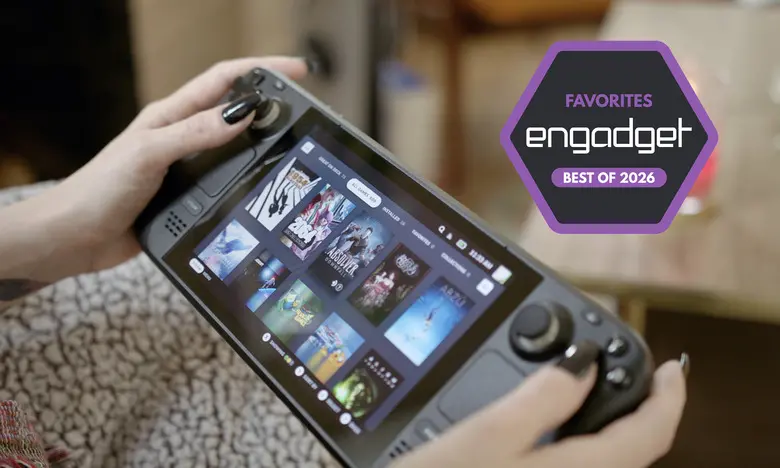
Handheld gaming systems are no longer a niche category. Today's devices range from compact retro emulation machines to full-fledged portable PCs capable of running modern AAA games. That variety is exciting but also makes shopping harder. The "best" gaming handheld now depends less on a single standout device and more on how, where, and what you want to play.
Some handhelds are designed for quick sessions and classic libraries, prioritizing simplicity, long battery life, and pocketable designs. Others blur the line between console and PC, offering large screens, powerful chips, and access to massive game libraries, often at the cost of size, price, or endurance. There are even experimental options that focus on unusual controls or intentionally limited experiences.
Best handheld gaming devices for 2026
Best handheld gaming PC for most: Steam Deck
The Steam Deck remains the best balance of price, performance, and usability in the handheld PC market. The Steam Deck OLED, starting at $549 for 512GB of storage, features a 7.4-inch HDR OLED display that is brighter, faster, and more vivid than the original's 7-inch IPS panel. It supports HDR, has a 90Hz refresh rate, and offers significantly better battery life than the LCD model—three to twelve hours depending on the game. The OLED model also runs cooler and quieter thanks to a larger fan and a lighter chassis.
The entry-level LCD Steam Deck, at $399, delivers the same core experience for $150 less, making it a fantastic budget option. It has a 7-inch 60Hz display and a 40Whr battery, but it can still play a vast library of Steam games. Both models support emulation through tools like EmuDeck, and SteamOS has become a flexible, user-friendly platform. The main downsides are bulkiness, aging hardware that struggles with some recent AAA titles, and incompatibility with games that require anti-cheat software like Destiny 2 or Apex Legends. The d-pad is also slightly mushy, but the contoured grips and responsive controls help offset the size.
- Pros: Enough power for many modern PC games, user-friendly interface, vivid OLED display (on OLED model), fantastic value (LCD model), superb emulation performance.
- Cons: Bulky, not the most powerful hardware, doesn't officially support every Steam game or games from other clients.
Best premium handheld gaming PC: Lenovo Legion Go S (SteamOS, Z1 Extreme)
The Lenovo Legion Go S is the closest thing we have to a Steam Deck 2. It is the first third-party device to natively run SteamOS, giving it the same conveniences and occasional compatibility issues as Valve's handheld. The Z1 Extreme configuration we tested comes with 32GB of RAM, a 1TB SSD, and a powerful AMD Ryzen Z1 Extreme processor that can draw up to 33W in handheld mode (40W plugged in). This makes it significantly better for resource-intensive games, often achieving 60 fps in recent AAA titles at settings the Steam Deck can't handle.
It features an 8-inch IPS display with a sharper 1920x1200 resolution, a 120Hz refresh rate, and variable refresh rate (VRR) support, which minimizes screen tearing. However, it lacks HDR and has lower peak brightness than the Steam Deck OLED. The device is a bit heavier than the Deck, but the rounded edges and textured grips make it ergonomic. Hall effect joysticks and dual USB-C ports are nice perks. Battery life is respectable, though the Deck often lasts longer on less demanding games. At $900, it's pricey, but for those who want to play recent blockbusters on the go, it's worth considering. A cheaper $650 version with a Z2 Go chip is also available, though we haven't tested it.
- Pros: Better performance than Steam Deck and most Windows handhelds, runs official SteamOS, spacious display with VRR, good ergonomics.
- Cons: Pricey, heavier than Steam Deck, no HDR support, weak haptics.
Best Windows gaming handheld: ASUS ROG Xbox Ally X
The ASUS ROG Xbox Ally X is our favorite Windows-based handheld. It runs Windows 11 and includes a new "Xbox full screen experience" that aggregates games from multiple storefronts, making navigation easier. The device is powered by an AMD Ryzen Z2 Extreme chip and 24GB of RAM, with a boost mode that can reach 35W when plugged in. This gives it a higher performance ceiling than the Steam Deck, making it better for demanding AAA games.
It features a 7-inch 1080p display with a 120Hz refresh rate and VRR, which keeps gameplay smooth even when frame rates fluctuate. Windows compatibility means you can play games from any PC client, including Epic, GOG, and Xbox Game Pass, without workarounds. The design includes comfortable pronged grips, an 80Whr battery that lasts around three and a half hours in demanding games, and a traditional Xbox controller feel. The main downside is the $1,000 price tag, plus the usual Windows quirks that still plague handhelds—touch navigation can be frustrating, and pre-installed apps like Teams are unnecessary. Overall, it's a luxury purchase, but it's the best option for those who want maximum software flexibility and performance.
- Pros: More powerful than Steam Deck, works with any Windows gaming client, 1080p 120Hz display with VRR, comfortable grips, supports new full-screen Xbox experience.
- Cons: Expensive, a bit bulky, Windows 11 still has quirks on handhelds, lackluster haptics, no included case.
Best mobile gaming handheld for most people: Retroid Pocket 5
The Retroid Pocket 5 is the go-to device for emulating older consoles. This Android-based handheld, priced at $219, is far less powerful than portable PCs but is much more compact. It runs on a Snapdragon 865 chip with 8GB of RAM and has a built-in fan with three modes. It can play most PS2 and GameCube games at full speed with upscaled resolution, and it handles everything below those systems flawlessly. Xbox cloud streaming and native Android games also run well.
The device features a 5.5-inch 1080p OLED display that is vivid and sharp, with textured grips for comfortable holding. The face buttons, d-pad, and Hall effect joysticks are all responsive. Battery life ranges from three to ten hours depending on the game. The biggest downside is the complexity of setting up emulators—expect to tinker with ROM files, drivers, and settings to get everything working. The joystick layout places the left stick under the d-pad, which can be uncomfortable for modern games, but for retro fans, this is a fantastic value.
- Pros: Capable emulation and Android gaming performance, lovely OLED display, great sticks and buttons, sturdy portable design.
- Cons: Requires a lot of tinkering, joystick layout isn't ideal for modern games.
Another good option: Retroid Pocket Flip 2
The Retroid Pocket Flip 2 is essentially the Pocket 5 in a clamshell design. It shares the same Snapdragon 865 chip, OLED display, Hall effect joysticks, active cooling, and 5,000mAh battery. Priced at $229, it offers the same wide range of retro emulation but with a DS-like clamshell form factor that provides natural screen protection. The controls are comfortable, though the recessed joysticks feel awkward, and the buttons and d-pad could be larger. The speakers are loud but lack separation. If you prefer a clamshell over a traditional handheld, this is a great alternative.
- Pros: Same capable emulation, sturdy clamshell design protects the screen, lovely OLED display.
- Cons: Requires tinkering, recessed joysticks, buttons could be larger.
Best mobile gaming handheld overall: AYN Odin 2
The AYN Odin 2 is a step up from the Retroid Pocket 5 for those willing to spend more. Starting at $299, it uses a Snapdragon 8 Gen 2 processor, which delivers smoother and more reliable emulation of PS2, GameCube, 3DS, and even some Switch games. It has a 6-inch 1080p IPS display that's bright and sharp, though not as color-rich as OLED panels. The device is larger than Retroid's options but still much smaller than a portable PC, with comfortable curved grips and offset joysticks. Battery life is superb—over eight hours of PS2 emulation and more than twenty hours for lighter tasks.
It includes a fingerprint scanner, micro-HDMI out, two custom back buttons, and front-facing speakers. The Android interface is familiar and easy to use. The Odin 2 is pricier than the Retroid Pocket 5, and setting up emulators still requires effort, but it's the best mobile emulation machine you can buy in 2026.
- Pros: Excellent emulation and Android gaming performance, comfortable, great battery life.
- Cons: Relatively pricey for a mobile handheld, setting up emulators is laborious, docked experience isn't seamless.
Best Game Boy-style handheld: Analogue Pocket
The Analogue Pocket is the ultimate Game Boy, priced at $220. It plays original Game Boy, Game Boy Color, and Game Boy Advance cartridges with near-perfect FPGA-based emulation. It also supports other systems via adapters, including Game Gear and Neo Geo Pocket. The 3.5-inch display is incredibly sharp (615 ppi) and backlit, with filters that mimic classic screens. It has USB-C charging, a microSD slot for ROM playback, and an optional dock for TV output. The build quality is premium, and battery life lasts six to ten hours. The main drawbacks are frequent stock shortages, spongy shoulder buttons, and tiny volume buttons.
- Pros: Plays Game Boy and GBA cartridges with near-perfect emulation, gorgeous display, impressive build quality, expandable via adapters.
- Cons: Stock issues and shipping delays, spongy shoulder buttons, tiny volume buttons.
Honorable mention: Playdate
The Playdate is a quirky handheld from Panic, priced at $229. It has a 2.7-inch monochrome display, a d-pad, two face buttons, and a physical crank. It plays a curated library of indie games, with a couple dozen bundled in. The device is tiny, well-built, and offers a unique gaming experience, but it's not for everyone—the display isn't backlit, and the games are niche. It's a fun toy for those who appreciate innovation.
What about the Nintendo Switch 2?
The Nintendo Switch 2 is already more popular than any of the handhelds above, but it exists in its own world. Most people aren't choosing between it and a Steam Deck or emulation device. The main reason to buy a Switch 2 is to play exclusive Nintendo games like Donkey Kong Bananza and Mario Kart World. The hardware itself is a significant upgrade over the original, with a sharper 7.9-inch display and magnetic Joy-Cons. However, the library of must-play exclusives is still limited, so there's no need to rush unless you have a serious case of FOMO.
Other gaming handhelds we've tested
We've also tested the Lenovo Legion Go 2, which has a huge 8.8-inch OLED display and detachable controllers, but it's heavy and expensive at $1,100. The MSI Claw 8 AI+ offers strong performance and good battery life, but at $1,100 it's hard to justify over the ROG Ally X. The ModRetro Chromatic is a premium Game Boy-style device that plays cartridges via FPGA, but it requires three AA batteries and lacks save states, making it a tough sell next to the Analogue Pocket. The Lenovo Legion Go S with the Z2 Go chip and Windows is underpowered for its $730 price. The Ayaneo Flip DS is a cool dual-screen Windows machine but suffers from a cramped layout, heat, and a high price. The Ayaneo Kun is powerful but huge and dated. The Retroid Pocket Classic is a budget-friendly vertical Android handheld with a great OLED display. The Retroid Pocket Mini is a smaller version of the Pocket 5 but has a 4:3 screen that's great for retro systems. The Retroid Pocket 4 and 4 Pro remain decent budget options. The Miyoo Mini Plus and TrimUI Brick are affordable vertical handhelds that are good for casual retro gaming. The Anbernic RG35XX Plus and RG35XXSP are also budget options but have poor stock software and quality control issues. The PlayStation Portal and Logitech G Cloud are streaming-focused devices that aren't ideal for emulation.
What to know about the gaming handheld market
The market splits into three tiers. At the top are x86-based portable PCs like the Steam Deck and ROG Ally X. These are the most powerful, capable of playing modern PC games and emulating the widest range of consoles. They're also the largest, heaviest, and most expensive, ranging from $400 to over $1,000. The middle tier consists of mobile handhelds like the Retroid Pocket and AYN Odin 2. These run Android or Linux and are more compact, but they can't handle modern AAA games. They're excellent for emulation and cloud streaming, though setting up emulators can be complicated. The third tier includes devices like the Switch 2 and Playdate that offer unique experiences with their own game libraries.
Recent updates
In November 2025, the ASUS ROG Xbox Ally X became our top Windows pick, replacing the older ROG Ally X. We added testing notes on the Lenovo Legion Go 2, ModRetro Chromatic, Retroid Pocket Classic, and TrimUI Brick. Several new devices, including the Retroid Pocket 6 and AYN Odin 3, have been announced, and we're working on testing them. In August 2025, we added the SteamOS version of the Lenovo Legion Go S and adjusted our Windows pick. The Nintendo Switch 2 was added as a separate note. We've also been tracking the growing number of SteamOS devices and the ongoing evolution of Windows handhelds.
Source:Engadget News