

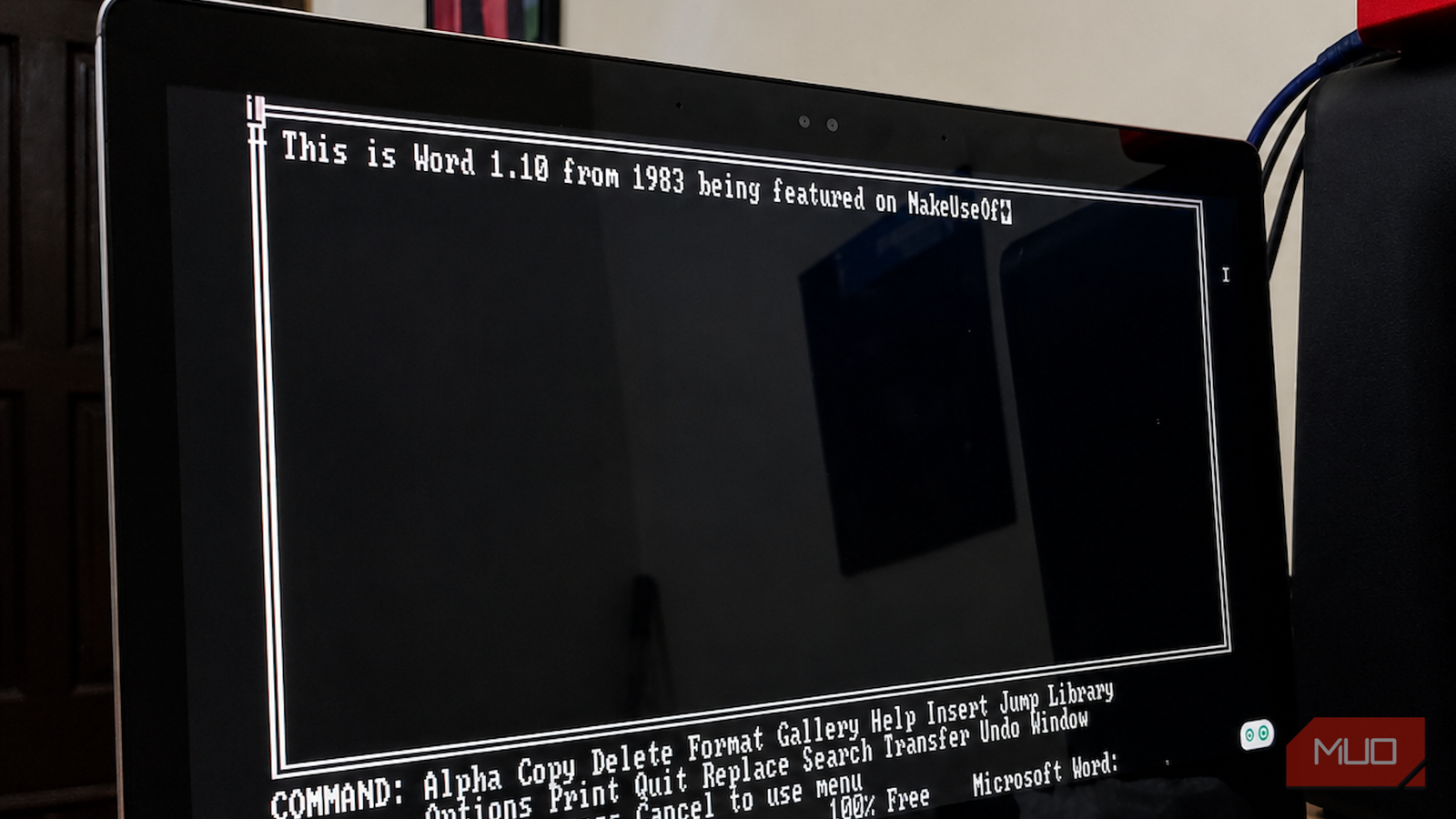
Microsoft Word and Windows are so tightly linked in many people's minds that it is easy to assume one essentially grew out of the other. The actual timeline is stranger and far more interesting. Word was already a real product before Microsoft even announced Windows, and MS-DOS was not where its development began. The earliest version was built for Xenix, Microsoft's own take on Unix.
That fact drops Word into a version of Microsoft that is now almost unrecognizable. Long before Windows became the center of the company's universe, Microsoft was willing to build software for whichever platforms looked promising. Word is one of the clearest leftovers from that much more adventurous era.
Key Facts at a Glance
- Microsoft announced Xenix, its Unix variant, in August 1980.
- Charles Simonyi joined Microsoft in 1981 after working on the Bravo text editor at Xerox PARC.
- Richard Brodie joined Simonyi and began work on Microsoft's new word processor in 1982.
- The program was first developed for Xenix in February 1983 under the name Multi-Tool Word.
- An MS-DOS version followed later in 1983; Word for MS-DOS 1.00 was released on September 29, 1983, according to Microsoft's corporate timeline.
- Microsoft announced Windows 1.0 in November 1983, but Windows 1.0 did not ship until November 20, 1985.
- Word for Macintosh was announced in January 1984 and appeared commercially in 1985.
- Word for Windows did not arrive until 1989.
- By 1993, Word for Windows was generating roughly half of word-processing market revenue.
Microsoft Had a Unix Phase Before Windows
Yes, That Microsoft
Microsoft announcing its own version of Unix sounds like an alternate-history detour, but Xenix was very real. Microsoft announced it in August 1980 as a portable Unix system for 16-bit processors. By 1982 the company was already running several Xenix machines on its internal network. Microsoft also worked with the Santa Cruz Operation to develop and support the system across different hardware.
Word came out of that version of Microsoft. Charles Simonyi joined the company in 1981 after years at Xerox PARC, where he had worked on Bravo, one of the early WYSIWYG text editors built for the Xerox Alto. He later brought in Richard Brodie, another former Xerox employee, and Brodie started work on Microsoft's new word processor in 1982.
The program initially went by the extremely 1980s corporate name Multi-Tool Word. The UK National Archives' PRONOM database says Simonyi and Brodie developed it first for Xenix in February 1983, with a version for MS-DOS, Microsoft's pre-Windows disk operating system, following later that year. Brodie has also said the first version was developed on Xenix, although that does not necessarily prove the Xenix build was the first to be sold commercially. Either way, Word's earliest development happened on Unix.
Microsoft gave the DOS release an aggressive debut. Its corporate timeline says that Word for MS-DOS 1.00 shipped on September 29, 1983, with a demo copy sent to PC World subscribers. The Computer History Museum puts the number of demo disks distributed at roughly 450,000. Microsoft's newer history of Word instead gives October 25 as the release date for Word 1.0, so the surviving chronology is not perfectly consistent. What is clear is that Word was already on the market in 1983, before Microsoft announced Windows 1.0 that November.
That choice of Xenix makes far more sense once you forget everything that happened to Microsoft afterward. Xenix was a serious part of its business, and Microsoft would later describe it as the most popular Unix variant by 1984. IBM even selected both Xenix and MS-DOS for its PC AT that same year, which shows how plausible both paths still looked before Windows took over Microsoft's future.
Word Was Already Preparing for a Graphical Future
The Mouse Showed Up Early to the Party
The Xerox connection helps explain why early Word felt so unusual for its time. Simonyi had spent years around Xerox PARC's pioneering work on graphical computing. At PARC he worked on software for the Alto, a machine with a bitmap display and a mouse years before either was standard PC gear. Bravo could show formatted text on screen in a form that closely matched the printed result, helping establish the WYSIWYG style of editing that is now taken for granted.
Microsoft carried much of that thinking into Word. The DOS version supported a mouse, style sheets, multiple windows, undo, footnotes, mail merge, and formatting that changed as the user typed. Contemporary PC displays could only take that idea so far, however. Simonyi later explained that the IBM PC's character-based display could approximate the visual editing experience, while details such as proportional character widths still needed a proper graphical display.
That ambition also helps explain why Word's early years were a bit bumpy. PC users were already familiar with products such as WordStar and, increasingly, WordPerfect, while Microsoft's program behaved differently and introduced ideas that were not yet common on DOS PCs. The Computer History Museum describes Word for DOS as an also-ran compared with WordPerfect, which is a long way from the dominance Word would eventually achieve.
Windows Eventually Caught Up With Word
The Obvious Pairing Took a Few Years
Even after Microsoft announced Windows, customers could not actually buy it yet. Windows 1.0 finally shipped on November 20, 1985, two years after Word had already appeared on DOS. Word itself was meanwhile moving onto another graphical platform.
Microsoft announced Macintosh software, including Word, alongside Apple's new Mac in January 1984, and the Mac version appeared commercially the following year. It was an early example in Microsoft's long history of building software for Apple. The platform was also a much more natural fit for the graphical editing ideas that Simonyi's team had been pursuing. In his Computer History Museum oral history, Simonyi described Microsoft as being especially well positioned for the Mac because its applications group already understood graphical interfaces.
Word for Windows did not arrive until 1989, six years after the original DOS release. The timing worked in its favor. Windows 3.0 followed in 1990 as an important step in Windows' evolution from its 1.0 beginnings, giving Word a much stronger graphical PC platform on which to showcase the interface Microsoft had been working toward for years.
Its fortunes changed quickly from there. According to the Computer History Museum, Word for Windows was generating roughly half of word-processing market revenue by 1993, a remarkable turnaround for a product whose DOS ancestor had struggled against WordPerfect. By then, the Word-and-Windows association that is now taken for granted was finally taking shape.
What sticks with me most is how clearly Word's early history captures a completely different Microsoft. This was a company that sold Unix, hired Xerox PARC veterans, and was happy to build major software for whichever platforms seemed worth betting on.
Word passed through Xenix, DOS, and the Mac before Windows became the platform that turned it into a giant. Looking back now, the Word-and-Windows pairing feels almost preordained, yet Word spent its first several years navigating a much wider software landscape while Microsoft was still figuring out which direction would define its future.
Source:MakeUseOf News