

Key facts at a glance
- Xiaomi officially revealed the Xiaomi 18 Fold during IFA 2026 in Berlin.
- It is the company's first flagship smartphone powered by the XRing O3 chip.
- The wide-screen foldable features a triple camera system and appears to cover a focal range from 17mm to 80mm.
- The device is scheduled to launch in China on September 7.
- Xiaomi is also showcasing more than 380 products and the European expansion of its Mijia smart home brand.
Xiaomi has officially taken the wraps off the Xiaomi 18 Fold at IFA 2026, giving consumers and press their first genuine look at the company's upcoming wide-screen foldable. The handset took center stage at Xiaomi's venue in Berlin, where the company reserved more than 3,300 square meters for its largest standalone overseas exhibition to date. Alongside the foldable, the showcase includes more than 380 products spanning smartphones, smart home devices, AI, personal mobility, and other technologies, making the event a milestone for Xiaomi's global ambitions.
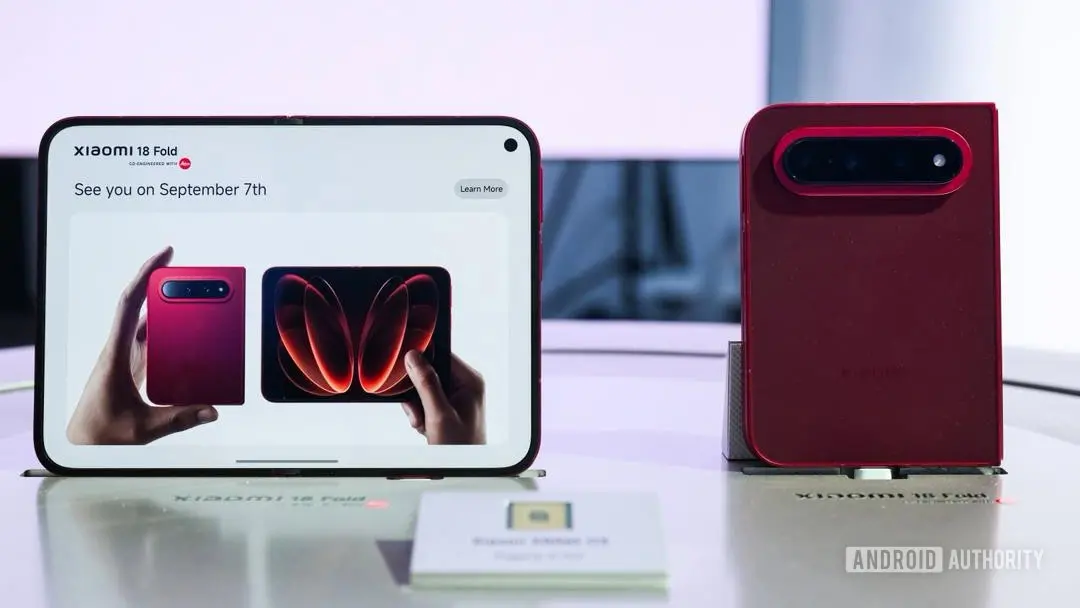
The 18 Fold did not arrive without advance notice. Prior to IFA, leaked images and official-looking renders had already surfaced online, hinting at a wide folding screen, a rear camera bar, and a color choice that would stand out in a crowded flagship market. Those details gained additional weight when Xiaomi published its own marketing visuals shortly before the trade fair opened. Now that the hardware is on display in Berlin, the most striking early takeaway is the cherry red finish. The color appears on the back panel and camera module, giving the device a more expressive look than many restrained foldables currently available.
A chip story that matters
The Xiaomi 18 Fold will be remembered for its form factor, but the most strategic piece of the device lies underneath the display. Xiaomi has confirmed that this is its first flagship smartphone powered by the XRing O3 chip. The company has been working toward greater semiconductor independence for years, and the XRing platform represents the latest stage in that project. Using an in-house processor in a high-profile foldable sends a clear message about Xiaomi's technical ambitions and its willingness to put custom silicon at the center of its premium mobile products.
While a modern smartphone is always built from components supplied by multiple partners, the XRing O3 is positioned as the central pillar of the Xiaomi 18 Fold's performance, AI processing, and connectivity experience. Moving flagship duties to an internal chip could also give Xiaomi greater control over software updates, power efficiency, and hardware optimization. In a product category where differentiation is difficult, custom silicon may become one of the most valuable ways for Xiaomi to separate itself from rivals.
Complementing the chip is an unusually fast memory subsystem. Xiaomi says the 18 Fold will use ChangXin Memory Technologies' next-generation LPDDR6 RAM, which is capable of delivering data at rates up to 12,800 Mbps. This configuration could prove particularly useful for on-device AI features, high-resolution multitasking, and demanding games. The move also reflects Xiaomi's interest in building deeper relationships with component suppliers as the global smartphone supply chain continues to evolve.
Design details from the show floor
The unit on the IFA show floor confirms that the Xiaomi 18 Fold has a triple-camera arrangement on its rear panel. The camera bar carries text indicating a focal range from 17mm to 80mm. If those numbers are accurate, the system may include an ultra-wide lens at the short end, a main camera in the middle of that range, and a telephoto module at 80mm. That would translate to roughly 3.3x optical zoom when compared with a conventional 24mm primary camera. A camera system spanning such a wide range would give the 18 Fold extra flexibility for travel photography, portrait shots, and detailed close-ups.
Xiaomi did not disclose full camera specifications at IFA, so exact sensor sizes and aperture values are still unknown. But the physical layout and lens labeling suggest the company is aiming for a genuine all-purpose camera rather than a token multi-lens setup. The cherry red finish is likely to generate immediate reactions, especially among consumers who have grown tired of black, gray, and white foldables. The color choice is bold, and it matches a trend toward more personality in premium smartphones.
The rest of the phone's design appears to follow the wide-screen concept that Xiaomi has been exploring across recent products. The cover display looks closer to that of a traditional smartphone, while the inner display opens into a larger, more expansive canvas. Early hands-on impressions from the show floor emphasize the smooth opening mechanism and the reduced crease visibility, although full durability testing will have to wait until the device is available to consumers and reviewers.
Positioning between the Galaxy Z Fold 8 and the folding iPhone
Timing matters as much as hardware. The 18 Fold is arriving just after Samsung introduced what is described as its first wide-screen foldable, the Galaxy Z Fold 8. In that sense, the market appears to be moving away from tall, narrow cover displays and toward larger screens that feel closer to a regular phone when folded. Samsung has set the pace in the global foldable market, but Xiaomi is not far behind. The company has also been compared with Huawei's wide-screen Pura X Max, another device that has tested consumer appetite for a more expansive foldable experience.
Apple is still expected to enter the category with its first folding iPhone, which is also rumored to adopt a wide-folding design. With several major smartphone brands converging on the same concept, the launch window for the Xiaomi 18 Fold could be one of the most consequential in the segment's recent history. Xiaomi's challenge is to turn early curiosity into sustained sales. The foldable market has grown, but premium pricing, hinge durability concerns, and software optimization remain constant hurdles. The company hopes its combination of an in-house processor, large internal display, and capable camera hardware can appeal to customers who might otherwise wait for Apple or choose Samsung.
Xiaomi also benefits from having an established presence in China, where the 18 Fold will launch first. China has become an intensely competitive market for foldables, and the ability to offer custom silicon could help Xiaomi stand out among domestic rivals. The company has not revealed global pricing or international availability for the 18 Fold, but events like IFA are often used to test interest beyond Xiaomi's home market.
An ecosystem showcase in Berlin
The Xiaomi 18 Fold is only one component of what Xiaomi is doing in Berlin. The company is using IFA to emphasize its Human x Car x Home strategy, which tries to connect personal devices, automobiles, and household appliances through a common software ecosystem. To demonstrate the scale of that plan, Xiaomi has brought more than 380 products to its show floor, including phones, tablets, wearables, smart displays, robot vacuums, kitchen appliances, air conditioners, and electric vehicles.
The exhibition is also serving as the venue for the European expansion of Xiaomi's Mijia smart home brand. By giving Mijia a prominent placement at IFA, Xiaomi hopes to win over European consumers who may know the company mainly for its phones but not yet for its broader product ecosystem. Building a connected environment requires more than selling individual gadgets. Xiaomi's approach is to offer a seamless experience in which a Xiaomi phone can act as a control hub for Mijia devices, and an XRing O3-powered product could eventually enable faster and more intelligent local automation.
For now, IFA visitors will get to interact with much of this ecosystem in person. Xiaomi's multi-thousand-square-meter space is designed to show how the brand wants to fit into every part of a user's daily life. The 18 Fold is positioned as the mobile centerpiece of that vision, but the larger story is Xiaomi's evolution from smartphone maker to broad technology platform.
Xiaomi has already confirmed a China launch for September 7, meaning the gap between this IFA debut and consumer availability will be measured in days rather than months. With more product announcements likely during the show, and continued attention on the battle between the Galaxy Z Fold 8, the Xiaomi 18 Fold, and the expected foldable iPhone, the final stretch of 2026 is shaping up to be one of the most eventful periods for foldable phones since the category first appeared.
Source:Android Authority News