
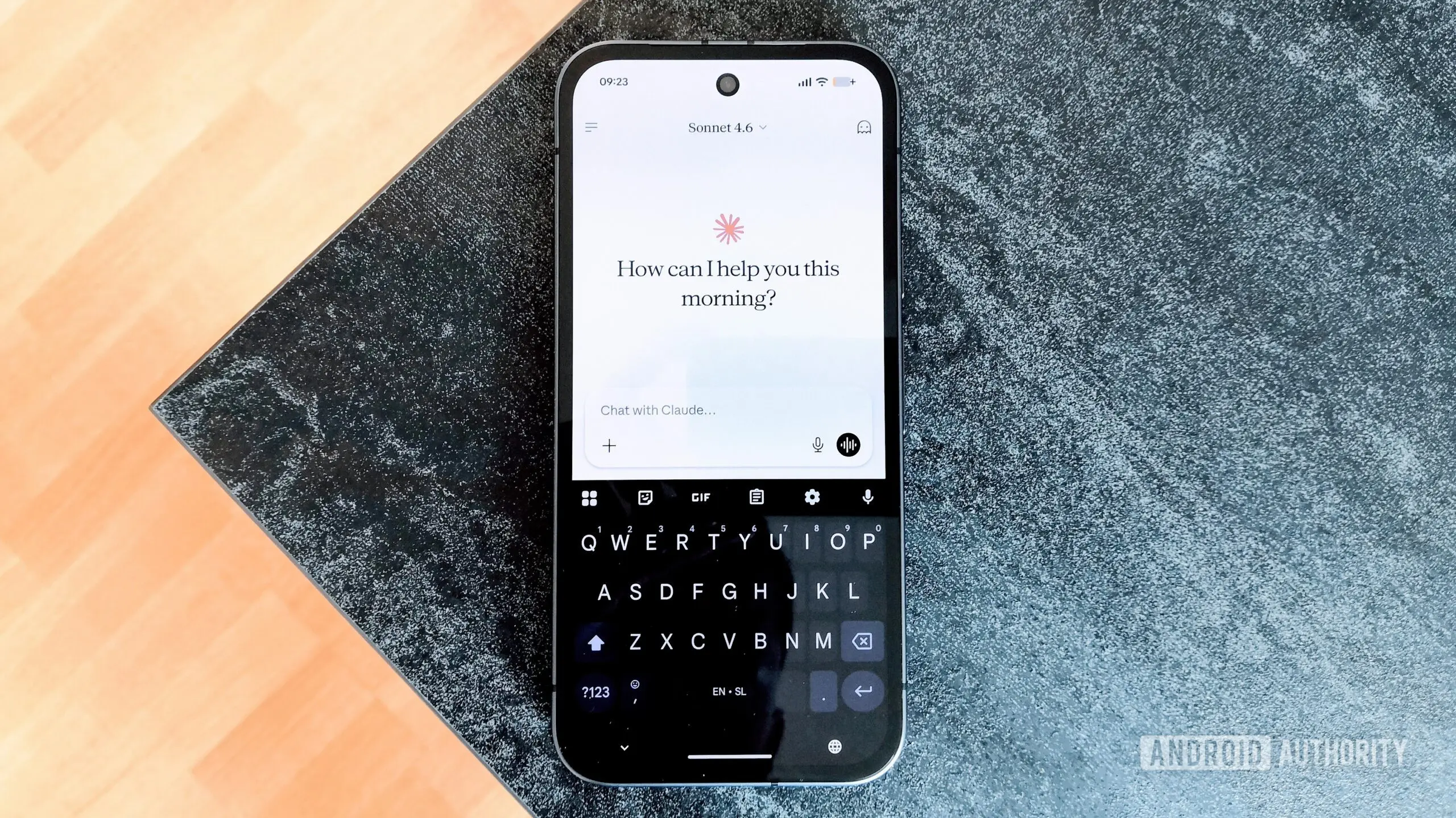
Anthropic has pulled back the curtain on how its Claude AI assistant embeds subtle watermarks into text it generates. The company first announced that Claude would support text watermarking last week, and it has now provided a detailed explanation of the underlying mechanism. The approach is designed to make AI-generated prose detectable without affecting readability or tampering with the words that appear on screen.
Watermarking has become a familiar idea in the AI industry. Google and OpenAI already use SynthID watermarks for images generated by their AI models. That system lets people check whether a shared picture was created by an AI rather than captured by a camera or edited by hand. Text, however, has always presented a harder problem. Unlike images, which can carry invisible patterns in pixels, text is made of discrete words and punctuation marks. Changing even one word can alter meaning, and adding hidden characters can break formatting or be stripped out by tools.
Anthropic says its new watermarking system for Claude is based on SynthID-Text, a solution published by Google DeepMind. It is not something readers will notice. The company says the watermark has no practical impact on the content or quality of generated text, does not introduce hidden characters, does not require extra tokens, and cannot be traced back to a specific person, organization, or chat session. That last point is important for privacy, because it means watermarking is not a way to identify who prompted a particular piece of text.
How Claude decides which words to use
To understand how the watermark works, it helps to know how large language models generate text. AI models like Claude produce text one word at a time, and each new word is chosen based on the words that came before it. The model assigns probabilities to a list of possible next words, then picks one. In many cases, there is an obvious choice. In other cases, several words might fit equally well.
Anthropic uses a simple example: "The weather today was cold and..." The next word is unlikely to be "sugary," because that would not make sense. It could be "overcast" or "grey," though. Both are reasonable, and most readers would not care which one the model chooses. These are the low-stakes decisions that make watermarking possible.
The company says that when watermarking is enabled, Claude still chooses randomly between words, but the source of that randomness is different. Instead of using the normal random process, it uses a random number that is related to a secret key. The result is a pattern spread across the entire piece of text. That pattern looks normal to a human reader, but anyone with the key can detect it.
Anthropic clarifies that Claude does not lean toward a particular word to create the watermark. The watermarking system does not force the model to consider a word it would not have considered before. It simply changes how a random choice is made among words that are already plausible. That is why the quality of the output remains the same.
What the watermark does and does not reveal
One of the most important details in Anthropic's explanation is that the watermark is not a universal AI detector. It can only answer one question: What is the likelihood this was partly written by Claude? It does not confirm whether text was written by a human. It also cannot tell whether the text was written by a different AI model, even if that model uses the same watermarking technique. Other AI systems would use different keys and possibly different methods altogether.
That means a piece of text generated by ChatGPT or Gemini would not be detected by Claude's watermark system. Conversely, if someone uses Claude and then edits the text heavily, the watermark might become harder to detect. The system is also not effective on very short passages. With fewer word choices, there is less information for the pattern to work with. As a passage grows longer, however, confidence in whether Claude wrote it also increases.
Where watermarking struggles
Anthropic also acknowledged that watermarking is less effective in certain types of text. Factual passages, for example, offer fewer opportunities for low-stakes choices. The company gives the example of the sentence "Isaac Newton's most famous work was called Principia..." The only accurate continuation is "Mathematica." There is no random choice to exploit, so no watermark can be embedded in that portion of text.
The same limitation applies when Claude is asked to proofread a user's own writing. The watermark will only appear in the corrections Claude makes, such as changes to punctuation or grammar. The original text written by the user remains unwatermarked. This is a sensible limitation, because proofreading should not turn a person's words into AI-generated content.
Generated code is another area with limited watermarking potential. Code often has strict syntax requirements and exact names for functions and variables, leaving little room for the kind of random choices that watermarking depends on. In many cases, there is only one correct way to write a line of code, and a watermark cannot be inserted without breaking it.
The growing push for text provenance
Anthropic's announcement is part of a broader push for provenance in the AI industry. Governments, publishers, and tech companies have all shown interest in ways to label AI-generated content. Images have received much of the attention so far, thanks to SynthID and similar tools. Text is more difficult, but it is also more important in some ways, because text is everywhere: news articles, school essays, product descriptions, social media posts, and more.
Watermarking is not the only approach to text provenance. Some companies have explored adding hidden characters to text, but those can be removed or cause formatting problems. Others have proposed using classifiers that analyze the statistical properties of text, but those can be unreliable and are often fooled by edits. Watermarking based on random word choices is appealing because it does not change the surface text at all. The words are still natural and the meaning is preserved.
There are still challenges. A determined user could ask Claude to translate the text into another language or heavily rewrite it, which would likely destroy the watermark. Paraphrasing tools may also weaken the pattern. Anthropic does not claim that watermarking is a silver bullet. Instead, it positions the system as one tool in a larger toolkit for understanding where text came from.
What comes next
Anthropic says it will soon offer a watermark detection API that will let developers and platforms check whether text was generated by Claude. That could make it easier for publishers, schools, and social media platforms to integrate Claude text detection into their workflows. The API would presumably accept a piece of text and return a score indicating how likely it is that Claude wrote it, based on the secret key.
The company has not said exactly when the API will be available or whether it will be free for all users. It has also not detailed how the system will handle edits, translations, or other transformations. Those details will matter for real-world adoption, because AI-generated text is rarely left completely untouched.
The move also raises questions about how other AI companies will respond. Google DeepMind published the SynthID-Text research, and Google already uses SynthID for image generation. OpenAI has also adopted SynthID for images. Neither company has announced a text watermarking system as openly as Anthropic has, though research continues. Anthropic's decision to build on SynthID-Text could set a precedent for collaboration across the industry.
For now, Claude's watermarking is best understood as a subtle layer of accountability. It does not interfere with the writing process, it does not expose private information, and it does not pretend to solve every problem. It simply leaves a faint trace that can be checked by someone who has the right key. As AI-generated text becomes more common, that faint trace could become a critical part of how readers verify what they see online.
Source:Android Authority News