

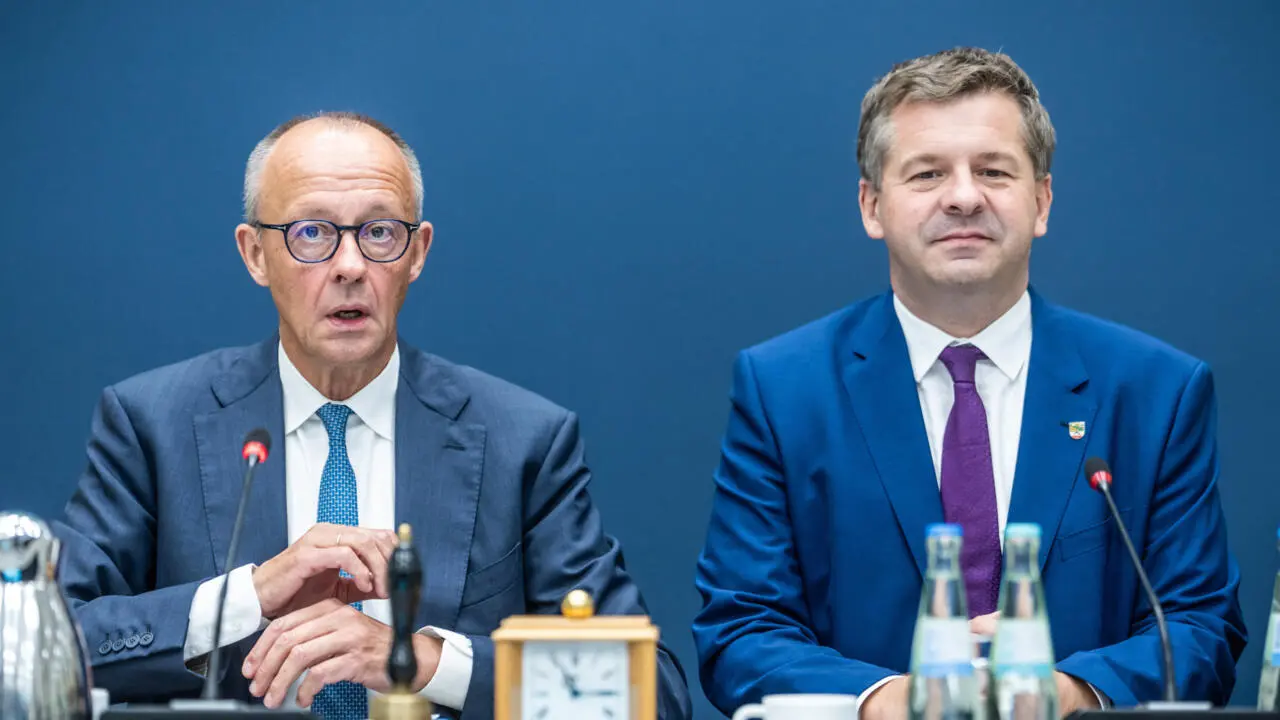
German Chancellor Friedrich Merz said on Monday that he was "deeply shocked" by the historic victory of the far-right Alternative for Germany (AfD) in the Saxony-Anhalt state election, as the party moved closer than ever to leading a German regional government for the first time since 1945. The anti-immigration, pro-Russian formation won 44% of the vote, according to official preliminary results, while Merz's conservative Christian Democratic Union (CDU) collapsed to less than 18%. The result deals a major blow to Merz, who came to power in May 2025 vowing to curb the AfD's rise, but has suffered a series of political setbacks since.
Addressing reporters alongside Sven Schulze, the outgoing state premier and defeated CDU candidate, Merz acknowledged that "something changed" in Germany after the vote. "My determination is to pursue the course of reforms, without a break, but I know that ... we must explain them better," he said after a meeting of the CDU leadership in Berlin. The chancellor's initial public reaction was one of bewilderment, using the word "shocked" to describe the outcome, while insisting that his government's social and economic reforms would stay on track.
A Historic First for the Far Right
Sunday's election in Saxony-Anhalt marks a watershed in post-war German political history. The AfD, founded in 2013 as an anti-euro fringe movement, has now become the strongest party in a German state parliament and is just three seats short of an absolute majority. Its leader in the state, the 35-year-old Ulrich Siegmund, was quick to claim a mandate to govern. "The voters have made us the strongest force, and we are ready to lead," he said, while thanking supporters and welcoming congratulations from Elon Musk overnight. Siegmund, widely described as charismatic and ruthless, has been a driving force in radicalizing the party's Eastern branches, pushing a hard-line anti-immigration agenda and cultivating close ties with Moscow.
The party's triumph in a state that was part of communist East Germany until 1990 follows its strong performance in the 2025 federal election, when it became the second-largest force in the Bundestag. But winning a state government has long remained an unattainable goal because all mainstream parties refuse to form coalitions with the AfD. That "cordon sanitaire" or firewall remains intact for now: the CDU, the Social Democrats (SPD), the Greens and the Left have all ruled out any cooperation with Siegmund's party. However, with nearly half the electorate backing the far right, political observers say the pressure on the firewall has never been greater.
Merz Under Fire
Friedrich Merz, who became chancellor only fourteen months ago after leading his party to a narrow victory in the 2025 federal elections, is now facing an existential crisis. His conservative-liberal economic agenda and his promises to harden Germany's migration policy have failed to resonate with voters in the east. According to research published in June 2026, Merz had the support of only 14% of voters, a stunningly low figure for a sitting chancellor. Intra-party discontent has been growing for months, and Sunday's debacle has reignited speculation about his future. Paul Maurice, secretary general of the Franco-German Relations Studies Committee at IFRI, noted that "days might be numbered. Internal battles within the CDU are underway. Merz arrived with a clearly right-wing program, but critics accuse him of not implementing the conservative, economically liberal program on which he campaigned in 2025. Therefore, conservative voters are gradually drifting toward the far right."
CDU officials interviewed after the vote were unsparing. "We are paying the price for Merz's bad policy in Berlin. I have been a super supporter of Merz, but voters are not stupid," said one party member, echoing a sentiment that was widespread among Christian Democrats in Saxony-Anhalt. Even the party's youth wing, which had enthusiastically backed Merz during his rise, turned on him. Fabian Theige, a member of the Christian Democratic youth organization, said: "What he is doing is frightening. Let's hope this result makes the message of the people heard."
The chancellor has promised to adjust his communication style but not his substance. He remains convinced that his reforms, including cutbacks in social benefits and stricter controls at Germany's borders, are necessary to revive the economy and to reduce pressure on public services. He argued that the AfD's success was largely a protest vote against the government in Berlin, and that the answer was to demonstrate that reforms will deliver results over time.
Voter Mobilization and Protest
Sunday's turnout reached 78%, a remarkably high level for a regional election, and analysts said the strong mobilization clearly benefited the AfD. Exit polls showed that a majority of voters who supported Siegmund said they did not necessarily share his party's ideology but wanted to punish the federal government and particularly the CDU. The AfD also drew votes from the CDU, while support for former coalition partners collapsed. Several voters interviewed by reporters outside polling stations said they were "desperate" about inflation, housing costs and unemployment in the region. One said: "The established parties have all had their chance. We want a fundamental change, not just in Saxony-Anhalt but across Germany."
German newspapers reacted with varying degrees of alarm. Der Spiegel, a left-leaning weekly, wrote that "it is shocking that this is possible in Germany, 80 years after the end of the Third Reich responsible for the Second World War, the Holocaust and other horrors," invoking the country's painful history. The mass-market tabloid Bild, by contrast, defended the electorate: "Voters deserve respect. They are desperate about the state of our country. The established parties have been swept away." The Münchner Merkur described the result as "an execution" for Chancellor Merz, while Berlin's Tagesspiegel argued that "the AfD's triumph is a final warning to Merz and to the established parties."
A Radicalized Party
Experts point not only to the electoral earthquakes but also to the changing nature of the AfD. Paul Maurice said that the party's program should not be confused with the conservative CDU politics of the 1990s. "This is a program that carries, it must be said, neo-Nazi undertones," he said. "Especially in the east, there are ideologues of the far right who have pursued a strategy of entering the party and reorienting its ideological content, making it truly a laboratory for a renewed, ideologized far right very close to Russia and also to Elon Musk, who congratulated Ulrich Siegmund." Indeed, Siegmund has fostered an openly revisionist course, questioning Germany's post-war guilt and advocating closer alignment with Vladimir Putin's regime as a counterweight to the United States and the European Union. This distinctly anti-Western, or at least anti-EU, profile has allowed the AfD to tap into economic resentment in eastern Germany, where industries have struggled through energy transition and globalization, and where many citizens feel left behind by the political system.
Yet the party also maintains a more moderate façade on the national stage, embodied by its federal co-leader Alice Weidel, who has sought to present the AfD as a normal conservative force. On Sunday evening, Weidel and Siegmund both extended a "hand" to parties to form a government, saying they were ready to take responsibility. But all mainstream parties remain hesitant, not only because of the party's radical elements but also because of recent legal proceedings against several AfD politicians accused of using fascist slogans.
Coalition Arithmetic
According to projections by Germany's public broadcasters, the AfD won about 39 of the 81 seats in the Saxony-Anhalt state parliament, leaving the party three seats short of the absolute majority needed to govern without partners. This has led to speculation about potential defections from other parties or a minority government. The CDU, which sank to under 18% and lost dozens of seats, has excluded any alliance with the AfD, and the other parliamentary forces have done the same. The dilemma facing the state is stark: if no coalition is formed, the Alternative for Germany could rule as a minority government, or the state could face a prolonged political crisis.
For Friedrich Merz, already weakened by his low approval ratings, this regional defeat deepens a growing vulnerability. While CDU leaders have stopped short of openly calling for his resignation, several party insiders say that his authority is now seriously compromised. The chancellor, however, remains defiant, insisting that his policies are the only way forward and that he will fight to win back the voters who turned to the AfD. "We must explain our reforms better," he said on Monday. "But we will not change our course because of a single election."
Meanwhile, the next federal election is still more than two years away, and the AfD continues to gain momentum across the country. Polls indicate that the party is now the preferred choice of a significant minority of German voters, particularly in the east. Whether the established parties can preserve the cordon sanitaire or whether Germany enters uncharted political waters remains to be seen, but the results in Saxony-Anhalt have already sent a shockwave through Berlin and beyond.
Source:RFI News