

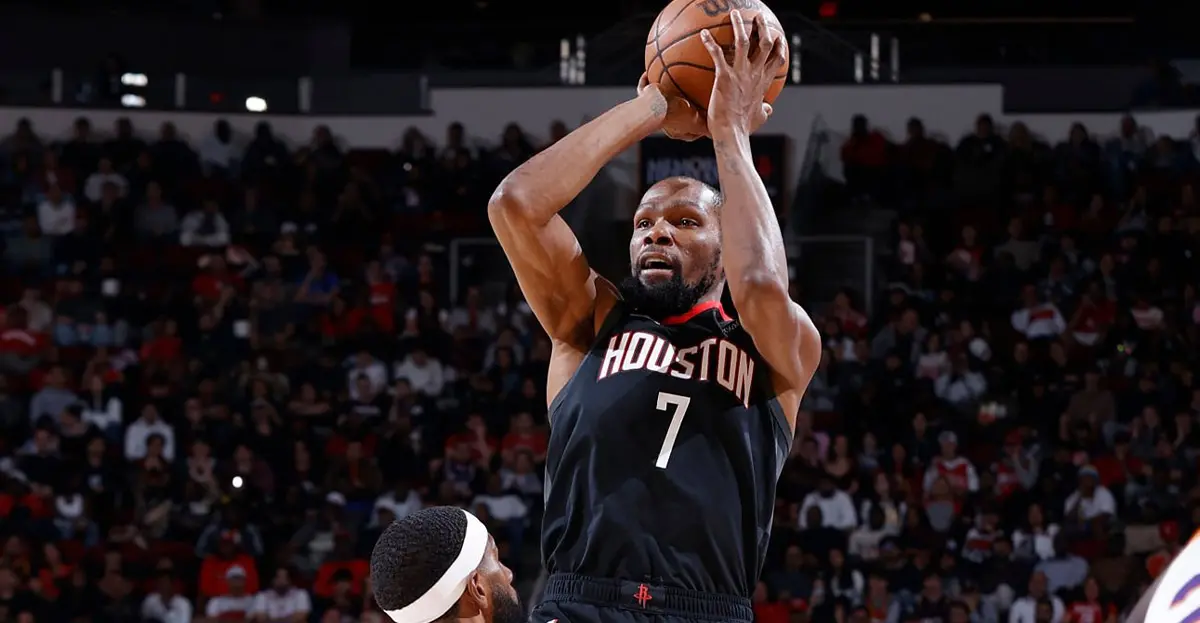
Kevin Durant has reached an age when most NBA legends begin to slow down, yet he is spending another summer searching for the smallest details that can extend his prime. The 37-year-old forward, widely regarded as one of the most unstoppable scorers in league history, has once again chosen to refine his game rather than simply rest on his résumé. This offseason, his work with longtime trainer Jamal “Dash” Lovell has centered on a very specific issue: how to handle double teams more effectively.
Why double teams remain a problem for Durant
Durant’s unique combination of size, shooting range, and ball-handling has made him virtually impossible to guard one-on-one for most of his career. Standing around 6-foot-11 with a 7-foot-5 wingspan, he can shoot over any defender, attack the rim with long strides, and create his own shot from almost any spot on the floor. Because single coverage rarely stops him, opponents often send a second defender to force the ball out of his hands. This tactic has been a constant throughout his career, but it becomes even more important in the playoffs, where schemes are designed to make stars work for every possession.
Lovell says the goal this summer is to make Durant even more dangerous when those extra defenders arrive. “We’re really working on him staying low and we’re sending a lot of double teams at him,” Lovell explained. “We’re doing a lot of live situations. We’re really trying to make it hard for him and working on his passes to get out of double teams.”
To replicate game conditions, training sessions have included occupied spaces, forcing Durant to operate in tight areas. “We’re filling the floor so he has to play in small, congested spaces,” Lovell added. This type of drill is designed to prepare him for the moments he will face against elite defenses that want to trap him near the sideline or in the pick-and-roll.
Film study led to a new development plan
The decision to focus on this part of his game was not random. Durant’s camp reviewed footage from last season and identified several situations where the veteran could still make better decisions. Even at his age and with his scoring ability, there were possessions in which he lost the ball while trying to escape a trap. Lovell explained that the main objective is to turn those losses into clean passes, especially when fatigue becomes a factor.
“When teams send double teams at him and he is tired, we want him to improve so he doesn’t turn the ball over trying to get out of it,” Lovell said. “So it’s about making sure he improves as a passer against double teams. That was one of our areas of focus after watching his games.”
The approach is not about overhauling Durant’s style or questioning his playmaking instincts. Lovell was quick to point out that Durant already knows how to pass the ball at an elite level. The point of the summer sessions is repetition. By practicing these reads over and over again, Durant hopes to make his reactions automatic when defenses try to trap him in real games.
A growing need for Durant to create under pressure
Durant has always been more than a scorer. He has demonstrated strong playmaking ability throughout his career, particularly during his time with the Brooklyn Nets, where he frequently initiated the offense and averaged career-high assist numbers. Still, there have been stretches where he chose to force shots through contact instead of making the extra pass. This was especially visible during the moments when his teammates struggled to knock down open looks, or when the offense lacked a reliable secondary creator.
In Houston, those moments became more frequent than expected last season. The Rockets signed Durant during the 2025 free-agency period to serve as the veteran anchor for a young and rising team. But injuries forced him to take on even more responsibility. Fred VanVleet, the team’s starting point guard and one of its best decision-makers, was sidelined for a significant stretch. Without him, Houston often looked to Durant to initiate sets, create advantages, and bail out broken plays. That extra workload took a toll, especially when teams loaded up on him defensively.
Durant’s ability to pass out of double teams became an even more valuable skill under those circumstances. If he can calm down, survey the floor, and fire quick passes to open shooters or cutters, opposing defenses will pay for sending extra bodies. That is exactly what Lovell has been trying to reinforce during the summer workouts.
Durant still producing at an elite level
Despite turning 37, Durant continues to post impressive numbers. Last season, he averaged 26.0 points, 5.5 rebounds, and 4.8 assists per game while shooting 52.0 percent from the field and 41.3 percent from three-point range. Those numbers would be considered outstanding for a player in his prime, let alone for a 37-year-old entering his 20th NBA season. His scoring remains effortless, and his shooting efficiency has barely dipped with age.
Durant has also shown remarkable durability in recent years. After dealing with an Achilles injury that forced him to miss an entire season with the Golden State Warriors, he returned to action in the 2020-21 season and has consistently played at a high level. Over the past two seasons with the Phoenix Suns and then Houston Rockets, he has remained available for the majority of games, silencing many concerns about whether his body could hold up.
Some players at this stage of their careers would avoid the gym or rely solely on their talent. Durant takes the opposite approach. His trainer is still impressed by the level of curiosity and humility he brings to training.
“You never see a Hall of Famer look at you and ask, ‘Am I doing this correctly?’ He wants us to teach him things at this age,” Lovell said. “That’s rare.”
Durant’s place among the all-time greats
The discussion around Durant’s legacy has shifted in recent years. He has won two NBA championships, earned two Finals MVP awards, and claimed one regular-season MVP trophy. He has also won multiple Olympic gold medals with Team USA, including the 2024 Paris Olympics, and has been selected to numerous All-NBA and All-Star teams. At this stage of his career, the only remaining debates center on his place among the greatest scorers and the best players in the history of the sport.
Many analysts place him in the top 10 or top 15 of all-time, with some ranking him as high as number six or seven. His ability to score in every conceivable way—off the dribble, from mid-range, behind the arc, and at the rim—makes him a unique offensive weapon. He has also developed into a solid defender when locked in, using his length to block shots and disrupt passing lanes.
What makes Durant’s current development so fascinating is that he is still adding to his game after so many years of dominance. The list of superstars who keep working on their weaknesses at age 37 is very short. Most rely on past success and natural ability. Durant, by contrast, appears driven by the same hunger that made him a highly sought-after prospect out of Montrose Christian School and then the University of Texas.
Houston’s improving supporting cast
The Rockets are hoping that Durant’s summer work will pay off in 2026-27. They also expect that their roster will be healthier and deeper than it was at times last season. VanVleet is scheduled to return as the primary point guard, which should ease the creation burden on Durant. The addition of Marcus Smart, a seasoned defender and capable playmaker, gives Houston another veteran who can handle the ball and make sound decisions under pressure.
Smart’s presence should also benefit Durant defensively. Durant will no longer be asked to carry as much of the playmaking load, and he can focus more on scoring and playing off his teammates. That could extend his effectiveness, especially during the regular season, and allow him to save energy for the playoffs.
The Rockets have built an intriguing mix of young talent and veteran leadership. With Jalen Green, Alperen Sengun, Jabari Smith Jr., and other promising young players, the franchise has plenty of upside. Adding Durant to that core made them an immediate contender in the Western Conference, and the return of VanVleet and Smart should provide even more balance.
What the training sessions look like on the court
Durant’s workout routine with Lovell is not simply a series of shooting drills. The sessions are designed to simulate game pressure. Lovell said the staff sends multiple defenders at Durant and fills the floor so that driving lanes become crowded. The idea is to make it uncomfortable for the veteran, so that he must think quickly and execute clean passes under duress.
Durant has always been willing to experiment with new movements and techniques. He has worked on post-ups, ball screens, catch-and-shoot opportunities, and isolation plays throughout his career. Adding advanced trapping and passing reads to that list only increases the number of ways he can hurt opposing defenses.
It also helps that Durant is unselfish by nature. He has never been the type of superstar who insists on shooting every possession. He routinely makes the extra pass and has played alongside other high-usage stars like Russell Westbrook, Stephen Curry, and Kyrie Irving. That experience has taught him how to share the ball and adjust to different offensive systems. This summer’s work on double teams can be seen as another extension of that team-first mentality.
The challenge of learning while at the top
Kevin Durant’s willingness to learn may be the most underrated part of his greatness. At 37 years old, with more than 30,000 career points and two Finals MVPs, he still asks his trainer for feedback. He still wants to know if his footwork is correct and if his escape passes can be sharper. That attitude is rare in any sport, and it explains why Durant has been able to keep evolving as the game changes around him.
His rivals have taken notice over the years. Players such as LeBron James and Stephen Curry have also managed to stay elite well into their 30s by adding new elements to their games. Durant appears determined to follow the same path. This offseason is proof that he is not finished growing.
The specifics of his double-team work will be tested when the Rockets face the league’s best defensive teams. There will be nights when the opponents send blitzes at him from the first possession to the last. With more practice and better passing reads, Durant should be prepared. If the extra work turns a few turnovers into open three-pointers for his teammates, Houston’s offense could become even more dangerous than people expect.
For a franchise aiming to compete at the highest level, that is an encouraging thought. For opposing defenses, it is a warning that the future Hall of Famer is still finding ways to improve.
Source:BasketSession.com - Le meilleur de la NBA : news, rumeurs, vidéos, analyses News