

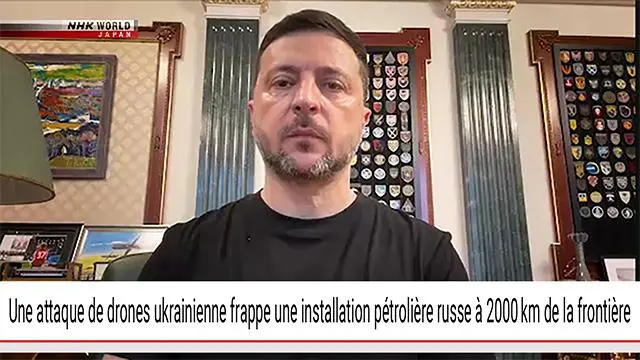
President Volodymyr Zelenskyy confirmed on Saturday that Ukrainian forces successfully struck a Russian oil processing facility located in the Tyumen region of western Siberia, more than 2,000 kilometers from the Ukrainian border. In a video address, he described the attack as a precisely coordinated drone operation that targeted infrastructure critical to Russia's war economy. The facility is part of Russia's vast energy network, which has become a focal point of Ukraine's long-range strike campaign.
The drones used in the operation were developed and modernized by a Ukrainian defense company, according to Zelenskyy. He stated that these unmanned aerial vehicles have an operational range of up to 3,000 kilometers, enabling them to reach deep into Russian territory. This capability marks a significant advancement in Ukraine's domestic drone production, reflecting a strategic shift toward asymmetric warfare to counterbalance Russia's conventional military advantages.
Zelenskyy framed the attack as a fully justified response to ongoing Russian strikes against Ukrainian civilian infrastructure and military positions. Since the full-scale invasion began in February 2022, Russia has launched thousands of missiles and drones targeting Ukrainian power grids, residential areas, and industrial sites. Saturday's attack, he argued, was not an act of aggression but a defensive measure aimed at degrading Russia's ability to sustain its war effort.
Ukraine has increasingly focused on disrupting Russia's energy sector, which provides Moscow with crucial revenue to finance its military operations. Analysts note that repeated strikes on oil depots, refineries, and processing plants could eventually force Russia to reconsider its military strategy. By targeting facilities far from the front lines, Ukraine aims to demonstrate that no part of Russia is safe from retaliation.
In addition to the Tyumen strike, Ukraine also claimed responsibility for attacks on other Russian energy assets. On Sunday, Zelenskyy posted on social media that Ukrainian forces had struck a fuel depot in Crimea, the peninsula illegally annexed by Russia in 2014. The attack on Crimea, which Russia considers a strategic foothold, underscores Ukraine's willingness to challenge Moscow's control over territory it claims as its own.
Earlier in the week, Ukraine hit a refinery near Moscow, causing fires and disruptions. That strike, occurring in close proximity to the Russian capital, sent a clear message about the reach and precision of Ukrainian drone capabilities. Such operations have become more frequent in recent months as Ukraine refines its drone technology and expands its production base.
The Ukrainian drone program has evolved rapidly since the start of the war. Initially reliant on imported components and commercial drones, Ukraine has developed a domestic industry capable of producing long-range attack drones. These systems often incorporate advanced navigation and targeting systems that allow them to evade Russian air defenses. Western analysts have noted that Ukrainian drone strikes have grown in sophistication, targeting critical infrastructure with increasing accuracy.
Meanwhile, the human toll of the war continues to mount. On Saturday, Russian missile and drone attacks killed seven civilians in different parts of Ukraine, according to local officials. Zelenskyy urged Ukrainians to take air raid alerts seriously, warning that Russia was preparing a new massive strike. He stressed the importance of staying in shelters and following safety protocols, especially as winter approaches and energy systems remain vulnerable.
The Ukrainian president's warnings come amid a broader escalation in hostilities. Russia has intensified its aerial bombardments in recent weeks, using large numbers of drones and missiles to overwhelm Ukrainian air defenses. The Ukrainian military has reported intercepting a significant percentage of incoming threats, but the sheer volume of attacks has caused damage and casualties.
International reactions to Ukraine's long-range strikes have been mixed. Some Western allies have provided Ukraine with advanced drone technology and intelligence support, though often with restrictions on using weapons against targets deep inside Russia. Ukraine argues that such constraints limit its ability to defend itself effectively. The United States and European Union have imposed sanctions on Russia's energy sector, but Ukraine believes that direct military action against oil infrastructure is necessary to cripple Russia's war economy.
The strategic logic behind Ukraine's targeting of oil facilities is multifaceted. First, it reduces Russia's ability to refine crude oil into fuel for military vehicles and aircraft. Second, it disrupts domestic fuel supplies, potentially causing economic strain and public discontent in Russia. Third, it sends a psychological signal that Ukraine can reach any part of Russia, undermining the perception of security among the Russian population.
Despite the risks, Ukraine has pursued this strategy with increasing boldness. The Tyumen attack shows that no region is beyond reach. The facility struck is located deep within Siberia, far from the front lines and considered safe from conventional Ukrainian forces. The success of the operation highlights the growing capability and reach of Ukraine's drone arsenal.
Military experts caution, however, that such strikes alone are unlikely to force Russia to negotiate. Moscow has shown resilience in absorbing damage to its energy infrastructure, and its military operations in Ukraine continue despite the economic pressure. Nonetheless, the cumulative effect of repeated attacks could erode Russia's long-term capacity to wage war.
Zelenskyy has repeatedly called on Western partners to provide more air defense systems and long-range weapons. He argues that Ukraine needs the ability to strike deeper into Russia to stop attacks at their source. While some allies have supplied longer-range missiles, others have hesitated due to fears of escalation. The drone program, therefore, represents a homegrown solution to a critical operational need.
The campaign against Russian oil infrastructure is likely to continue as Ukraine seeks to maximize pressure before potential peace negotiations. Each successful strike not only damages Russian assets but also boosts Ukrainian morale and showcases the effectiveness of its domestic defense industry. For Russia, the attacks pose a persistent challenge that complicates its military planning and resource allocation.
As the war enters its third year, the conflict has evolved into a war of attrition, with both sides seeking ways to gain advantage. Ukraine's drone strikes represent a relatively low-cost, high-impact tactic that aligns with its broader strategy of imposing costs on Russia while minimizing Ukrainian casualties. The Tyumen operation is just one example of this approach, and future strikes are expected.
In his video address, Zelenskyy emphasized that Ukraine will continue to defend itself by all means available. He called on the international community to recognize Ukraine's right to self-defense under international law. The attack on the oil facility, he said, was a necessary measure to protect Ukrainian lives and restore territorial integrity.
The situation remains fluid, with both sides preparing for further offensives. Russia has amassed troops and equipment along the front lines, while Ukraine is reinforcing its positions and stockpiling munitions. The drone war over Russian skies is likely to intensify, with Ukraine seeking to demonstrate that its long-range capabilities are a permanent feature of the conflict.
Source:NHK WORLD News