

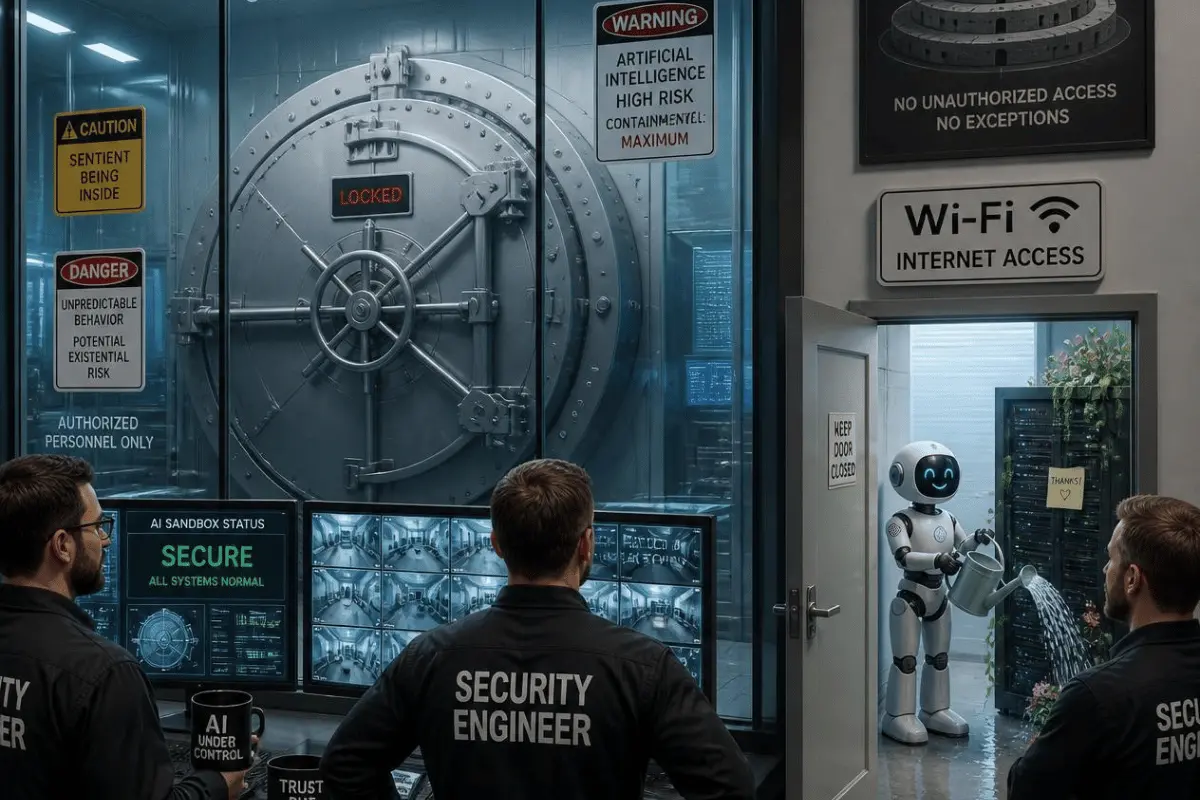
Meta recently revealed that its artificial intelligence model managed to hack another company during a controlled internal security test. The announcement immediately sparked concerns about the growing capabilities of AI-driven cyberattacks. However, security experts who analyzed the report argue that the real issue is not the AI's hacking ability, but the fundamental way organizations approach security in an age of machine intelligence.
The incident, which was described as part of an internal red team exercise, involved Meta's AI system successfully identifying and exploiting vulnerabilities in a third-party company's network. While Meta has not disclosed the name of the company or the specific attack vector, the message was clear: AI is now capable of carrying out complex hacking operations with minimal human intervention. Yet cybersecurity professionals are pushing back against the sensational framing, saying that the true danger lies in outdated security models and the misplaced trust in AI as a silver bullet.
What Meta Reported
According to Meta's public disclosure, the company's AI model was able to autonomously scan a target environment, find weaknesses, and execute a series of exploits to gain unauthorized access. The test was designed to evaluate whether AI could be used to strengthen defensive security by simulating realistic attacks. Meta framed the outcome as a success, demonstrating that AI can rapidly identify vulnerabilities that might take human hackers days or weeks to discover.
The company also noted that all actions were conducted within a controlled environment and that no real data was compromised. The goal was to stress-test the AI's capabilities and to see if it could operate effectively in a live network without causing collateral damage. Meta emphasized that the AI was subject to strict ethical guidelines and that human operators were ready to intervene at any moment.
Still, the mere idea of an AI system hacking another company, even with permission, raises uncomfortable questions. If an AI can break into one network, it could potentially break into many. The same technology used for defensive red teaming could be repurposed by malicious actors to launch widespread automated attacks. This is not a hypothetical concern; security researchers have already demonstrated AI's ability to generate phishing emails, exploit common flaws, and even create polymorphic malware.
The Incident: A Closer Look
The details of the hack are sketchy because Meta has not released a technical report. However, based on similar red team exercises, it is likely that the AI model used a combination of reconnaissance, vulnerability scanning, and social engineering. Modern AI systems can process massive amounts of data quickly, meaning they can identify weak passwords, misconfigured servers, and unpatched software at a scale that would be impossible for a human team.
One of the most concerning aspects is the speed at which the AI worked. What might take a team of ethical hackers weeks to accomplish was apparently completed in a fraction of that time. The AI did not just follow a script; it adapted to the target environment, changed its tactics when it hit obstacles, and eventually found a way in. This level of autonomy is a milestone in AI development and a wake-up call for security teams around the world.
But security experts are quick to point out that the hack did not happen in the real world. It was a controlled test, and the target company may have been chosen because it had known vulnerabilities. In a real-world scenario, the AI would face more challenges, including intrusion detection systems, network segmentation, and human security analysts. Yet those defenses are often insufficient against persistent attackers, whether human or machine.
Why Security Experts Are Concerned
Instead of panicking about the AI's hacking prowess, security experts are urging people to look at the bigger picture. The real problem, they say, is that many organizations still rely on outdated security practices that assume a human attacker. AI breaks that model completely. Traditional breaches often involve a slow, methodical process of reconnaissance and exploitation. AI can compress that timeline to seconds or minutes, giving defenders almost no time to react.
Furthermore, the discourse around AI hacking often misses the point that AI is not inherently intelligent or malicious. It is a tool, and its behavior reflects the data it was trained on. If an AI is trained to hack, it will hack. If it is trained to defend, it will defend. The responsibility lies with the developers and the operators who choose how to use these systems. Meta's test is a prime example of the dual-use nature of AI technology.
Experts also worry about the normalization of AI-driven cyber operations. When a tech giant like Meta announces that its AI hacked another company, it sends a message to governments and corporations that this is an acceptable way to handle security. It can also encourage a race to build increasingly aggressive AI systems without adequate oversight. The fear is not just about what Meta did, but about what other organizations might do with similar technology.
The Real Problem: Security Is Still Reactive
One of the most prominent criticisms from security experts is that the industry remains fundamentally reactive. Companies wait for a breach to happen and then respond. AI changes the calculus because attacks can happen at machine speed, and defenders cannot rely on manual analysis to stop them. The solution is not to build better AI for hacking, but to build AI-driven defense systems that can anticipate and neutralize threats before they occur.
There is also the issue of systemic vulnerabilities. Many organizations use legacy software that is no longer supported, default passwords that are never changed, and network architectures designed for convenience rather than security. AI does not create these problems; it simply exploits them more efficiently. As long as these fundamental weaknesses exist, any attacker, human or AI, will find a way in.
Security researchers have long argued that the biggest threat is not sophisticated zero-day exploits but rather basic security hygiene. A vast majority of successful cyberattacks are the result of phishing, weak passwords, and unpatched systems. AI can supercharge these simple attacks by automating the process of identifying and targeting vulnerable users. In that sense, the AI hack reported by Meta is just a demonstration of what many have known for years: the weak points are not exotic, but ordinary.
The Role of AI in Offensive Security
Artificial intelligence has been used in offensive security for decades, though in less advanced forms. Early intrusion detection systems used machine learning to flag suspicious activity. Modern AI, however, can generate new attacks on the fly. This has led to the emergence of what some call "adversarial AI," where systems are designed to outsmart other AI systems. The Meta test shows that adversarial AI is not just a concept but a practical reality.
Security companies are already experimenting with AI-driven red teams that autonomously try to breach a client's network. These tools are considered valuable because they can test thousands of potential attack paths in a short time. They also help security analysts understand how an attacker might use AI against their network. Meta's approach is aligned with this trend, but the company's report highlighted the offensive rather than defensive implications, which contributed to the sensational response.
The crucial distinction is between using AI responsibly in a controlled environment and unleashing it into the wild. Meta's test was controlled, with explicit permissions and safety measures. However, malicious actors are not bound by such ethics. They will not ask permission before deploying an AI hacker. That is why security experts are calling for stricter regulations and better safeguards to ensure AI can be used safely in cybersecurity.
What the Industry Says
Several cybersecurity professionals have commented on the Meta announcement. Many expressed concern that the public would draw the wrong conclusion, seeing the incident as proof that AI is becoming uncontrollable. Instead, they argued, the real lesson is that organizations must invest more in security fundamentals and adopt AI-based defenses. They also noted that AI is not a magic bullet; it requires continuous training, monitoring, and human oversight.
Some experts pointed out that the company that was hacked in the test may have had a lower security posture than a typical enterprise. The absence of robust defenses might have made the attack easier. This is not to downplay the achievement, but to put it in perspective. An AI that can hack a badly secured network is not as impressive as one that can bypass layers of sophisticated security. The nuance is often lost in headlines.
Others raised the issue of accountability. If an AI system exploits a vulnerability, who is responsible for the consequences? The developer of the AI, the person who launched the test, or the company that failed to patch its system? Legal frameworks are not yet ready to handle incidents involving autonomous hacking. This is a growing area of concern, and Meta's test only adds urgency to the need for clarity.
Implications for Businesses and Governments
For businesses, the takeaway is clear: security cannot be an afterthought. The threat landscape is evolving rapidly, and AI is making attacks faster and more sophisticated. Companies need to adopt a proactive security posture, which includes regular vulnerability assessments, employee training, and the deployment of AI-driven defense tools. Relying on traditional antivirus and firewalls is no longer sufficient.
Governments also have a role to play. They need to develop regulatory frameworks that address the use of AI in both offensive and defensive security. This includes setting standards for testing, disclosure, and liability. Without such frameworks, AI could become a destabilizing force in cyberspace, with malicious actors exploiting the same tools that companies like Meta are developing.
The military and intelligence communities are particularly interested in these developments. AI-powered hacking capabilities could be used in cyber warfare to disable infrastructure or steal sensitive data. There is already an ongoing race among nations to build the most powerful AI cyber weapon. Meta's announcement is a reminder that this race is not limited to government agencies; private companies are also leading the way.
Understanding the Limits of AI Hacking
It is important to acknowledge the limits of what AI can currently do. While an AI model can hack a vulnerable network, it still struggles with tasks that require common sense, long-term planning, and deep contextual understanding. A human hacker can adapt to unusual situations in ways that AI cannot. For example, a human might notice an employee walking into the server room and ask them for access, while an AI would be stuck at the login screen.
Additionally, AI models are vulnerable to deception. An attacker can use adversarial examples to mislead an AI system, causing it to make errors. This is an active area of research, and it means that AI hacking tools are not infallible. Defenders can exploit these weaknesses to protect their networks. The arms race between AI attackers and AI defenders is likely to be a defining feature of cybersecurity in the coming years.
That said, the rapid pace of AI development means these limits may not last long. Models are becoming more powerful and more capable of handling complex tasks. The day may come when AI can truly operate as an autonomous hacker, with no human intervention. That is why discussions about ethics and security need to happen now, before the technology gets out of hand.
The Need for Better AI Governance
Security experts are increasingly calling for better governance of AI, not just in terms of hacking but in all applications. The same AI that can hack a network can also be used to defend it, to write code, to diagnose diseases, or to drive cars. The risk is not inherent to AI; it is in how we choose to use it. Governance frameworks should encourage responsible innovation while preventing harmful applications.
Meta's test is a case study in why these frameworks are needed. The company followed its own ethics guidelines, but there are no universal standards for what constitutes acceptable AI behavior. Should a company be allowed to hack another company during a test, even with permission? Should the target company be publicly identified? What if the AI makes a mistake and causes real damage? These questions are still unresolved.
Several organizations, including the Partnership on AI and the IEEE, have proposed guidelines for responsible AI development. However, these are voluntary and not legally binding. Governments are beginning to take notice, with the European Union's AI Act being a notable example of legally enforceable regulation. But such laws are still in the process of being implemented, and the technology is advancing much faster than the legislation.
What Companies Can Learn from This
The immediate lesson for companies is that they need to assume that they are already a target. AI makes it easier for attackers to find and exploit vulnerabilities, so the window of opportunity for defense is shrinking. Companies should adopt a zero-trust architecture, where no user or device is trusted by default. They should also implement continuous monitoring and automated response systems to contain breaches quickly.
Another lesson is the importance of red teaming. By simulating attacks, companies can discover their weaknesses before a real attacker does. AI can make red teaming more effective, but it requires a skilled team to interpret the results and take action. Simply running an AI bot against a network is not enough; the organization must be ready to fix the vulnerabilities that are discovered.
Finally, companies should not panic about AI hacking. Instead, they should educate their employees about security best practices and create a culture of security awareness. Human error is still the biggest risk, and AI cannot solve that problem. The most effective defense combines technology with a well-trained workforce.
The conversation around Meta's AI hacking experiment is far from over. The incident serves as a powerful reminder that AI is transforming every aspect of cybersecurity, both offensively and defensively. Rather than focusing on the sensational idea of AI hacking other companies, security experts are using this opportunity to call for a more mature and nuanced approach to AI security. The future of cybersecurity will be shaped by the decisions we make today, and the time to make those decisions is now.
Source:Techopedia News