

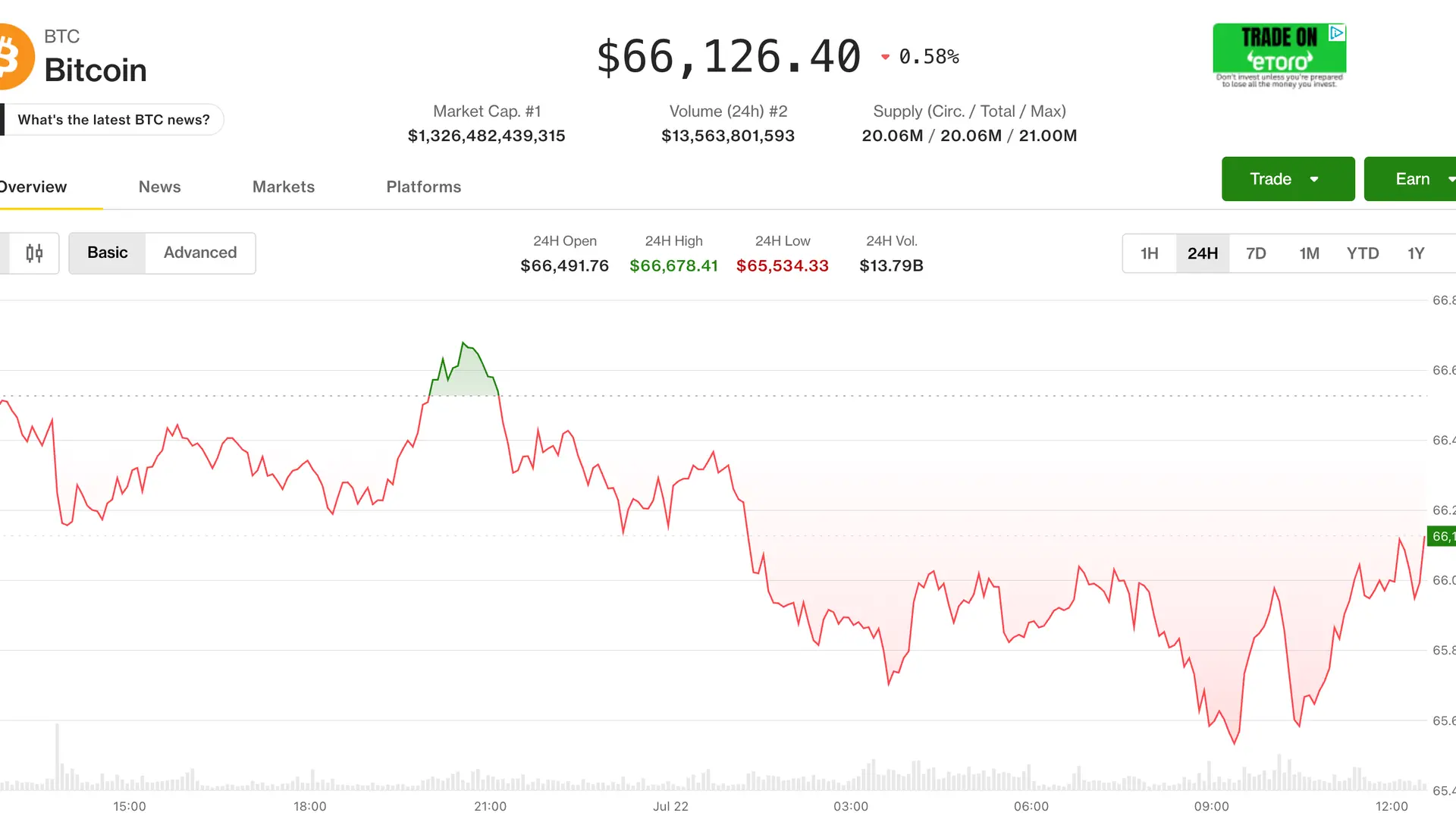
Bitcoin held near the $66,000 level on Wednesday evening, as U.S. equities recovered from a steep early decline amid a mix of geopolitical tensions, corporate earnings, and shifting central bank expectations. The cryptocurrency traded at around $65,840 at the time of writing, down about 1% over the past 24 hours but still within striking distance of its two-week high. The broader market saw the Nasdaq 100 and S&P 500 return to flat or modestly positive after being down more than 1% earlier, helped by a rebound in technology stocks.
Google Cloud Revenue Jumps 82%, Alphabet Beats Estimates
Alphabet (GOOGL) reported second-quarter results that topped Wall Street expectations, driven by surging demand for artificial intelligence services. The company posted $119.8 billion in revenue, ahead of analysts' $116.93 billion estimate. Google Cloud revenue climbed 82% year over year to $24.8 billion, easily surpassing the $22.4 billion forecast, which had implied 64% growth. The firm also reported a 30% increase in operating income as its operating margin expanded to 34%. Capital expenditure rose to $44.9 billion in the second quarter, doubling from a year earlier. CEO Sundar Pichai said AI investments are driving growth across the company, pointing to strong demand for Google Cloud Platform's AI infrastructure and enterprise AI solutions. Shares rose 0.4% in post-market trading after slipping 1.4% during the regular session.
The report was closely watched by investors as a bellwether for the AI trade. Markets have been whipsawed by fears that the massive spending on AI infrastructure may not generate returns quickly enough. Alphabet's results provided some reassurance, but the broader market remains cautious ahead of other Big Tech earnings.
Tesla Holds Bitcoin Steady in Second Quarter
Tesla (TSLA) did not buy or sell any bitcoin during the second quarter, maintaining its holdings at 11,509 BTC, according to the company's latest earnings release. The position was worth roughly $825 million at the end of the quarter. The company booked a $112 million after-tax impairment loss on its bitcoin holdings under accounting rules that require digital assets to be measured at fair value, with changes in value recognized in net income each reporting period. Tesla remains one of the largest publicly traded corporate holders of bitcoin, currently ranking as the 12th largest public holder. Elon Musk's other company, SpaceX, holds 18,712 bitcoin, placing it eighth.
The lack of activity from Tesla came as no surprise, as the company has not adjusted its bitcoin position for several quarters. However, the impairment loss highlights the accounting volatility that corporate holders face under current rules. The broader market also noted that Tesla's AI spending narrative diverges from other tech giants — investors want Tesla to spend more on AI, while for Alphabet they want evidence of returns.
Clarity Act Emerges but Passage Odds Decline
A new working draft of the Digital Asset Market Clarity Act began circulating in the U.S. Senate, offering the clearest look yet at legislation lawmakers hope to send to President Donald Trump before the end of the year. The latest text includes a provision barring the president and other senior government officials from holding direct crypto interests, though the restriction would expire in 2029 and leave the Department of Justice responsible for enforcing related ethics complaints. The ethics language has been one of the bill's biggest sticking points as lawmakers negotiate a final compromise.
Despite the progress, prediction market participants remain skeptical the bill will cross the finish line this year. Polymarket traders currently assign only a 39% chance that the legislation will be signed into law in 2026, down from nearly 50% earlier this week. The pullback in sentiment contributed to a slide in digital asset stocks on Wednesday. Coinbase fell 4.9%, Circle declined 7.6%, BitGo lost 5.7%, and Bullish was down 4.7% during the session. Bitcoin briefly dipped below $65,700 after trading above $66,000 earlier.
Oil Surge and Tariffs Add to Market Uncertainty
Markets faced a challenging mix of geopolitical tensions, trade uncertainty, and corporate earnings. Ryan Kirkley, co-founder and CEO of Global Settlement (GSX), noted that the renewed U.S.-Iran conflict, which pushed oil prices higher, and President Donald Trump's 50% tariffs on selected Canadian imports combined to create inflationary pressure that markets may be underestimating. Rather than viewing these developments as separate events, Kirkley argued investors should consider their cumulative impact on growth and central bank policy.
WTI crude oil surged another 3.2% to $87.38 per barrel, the highest since early June, after Trump escalated threats against Iran. The president vowed on Truth Social that any Iranian attack on ships in the Strait of Hormuz would be met with U.S. bombing of bridges or power plants in Tehran. The oil spike, along with rising Treasury yields, has fueled fears of persistent inflation. The 10-year and 2-year U.S. Treasury yields both hit fresh cycle highs on Wednesday morning. In response, traders ramped up bets on a Federal Reserve rate hike at the next policy meeting. The odds of a rate hike surged to 36% from less than 10% just one week ago.
Neocloud Stocks Outperform; OpenAI Ups Data Center Spending
Amid the broader market weakness, neocloud stocks outperformed as OpenAI reportedly increased its projected data center spending by 2030 from $600 billion to $750 billion, according to the Wall Street Journal. The investment is necessary for OpenAI to secure computing power for its AI models, including a new $20 billion campus in Georgia named Project Camellia. This news boosted shares of bitcoin miners pivoting to AI data centers, such as IREN, Hut 8, RIOT, and Keel Infrastructure, all up roughly 4% even as the Nasdaq slipped. Benchmark analyst Mark Palmer reiterated his buy rating on Hut 8 and raised his price target to $195, citing the company's second $9.8 billion, 15-year lease at its Beacon Point data center campus.
Bitcoin's $63,000 Floor in Focus
Technical analysts highlighted $63,000 as a key support level for bitcoin, where buyers have repeatedly stepped in. Holding above that level would suggest the recent correction is stabilizing, while a decisive break below could trigger another wave of profit-taking. To the upside, $65,000 to $66,000 remains the critical resistance band; a move back above it would improve momentum and strengthen the case for a push toward recent highs. Bitcoin's direction continues to be driven by the same three macro factors: the U.S.-Iran conflict, risk appetite through earnings season, and the Fed's policy path.
U.S. spot bitcoin ETFs posted their sixth straight day of net inflows on Tuesday, adding $203 million, the longest run since April. However, the total inflow over the six-day period was $930 million, less than half the $2.5 billion that exited during the eight-day outflow at the end of June. Total assets under management are now just shy of $81 billion, the highest since mid-June. Ether ETFs also saw net inflows of $37.5 million on Tuesday.
Looking Ahead
With Alphabet's earnings behind them, investors will turn their attention to the Federal Reserve's policy meeting next week. The odds of a rate hike have risen dramatically in the past week, and new Fed Chairman Kevin Warsh is not known for signaling intentions through leaks, potentially making market signals more important. The combination of oil-driven inflation, trade tariffs, and AI spending will continue to shape the market landscape. For bitcoin, the interplay between geopolitical risk and crypto-specific developments like the Clarity Act will determine whether the digital asset can sustain its recent gains above $66,000.
Source:Coindesk News