

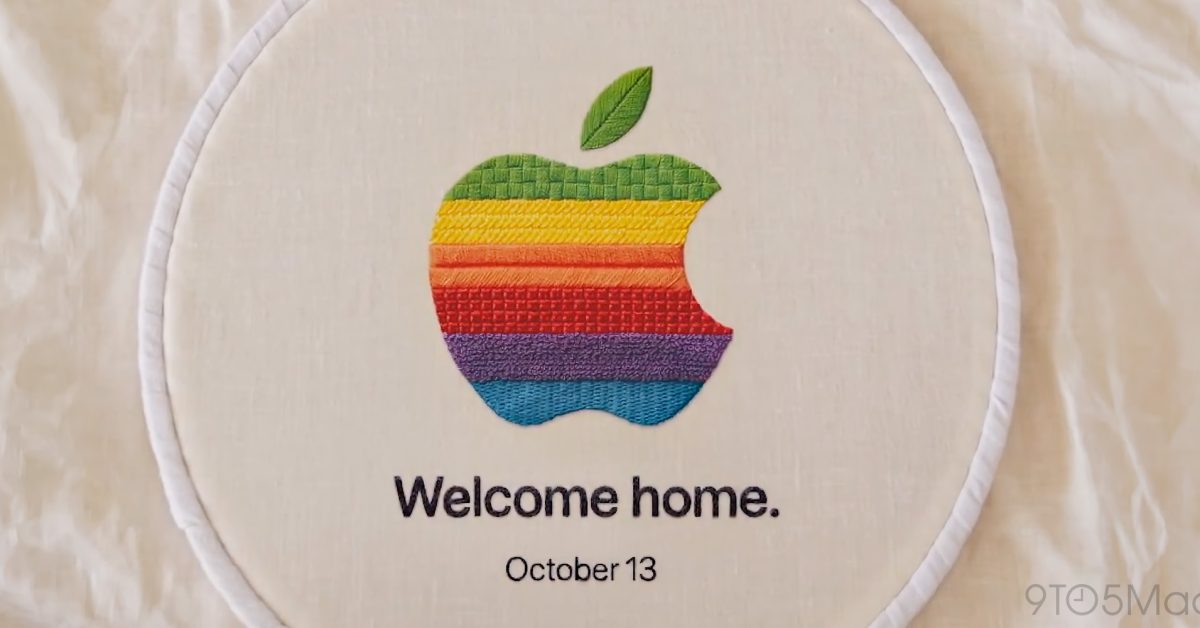
Apple Confirms Welcome Home Event for October 13
Apple has officially confirmed that it will hold a product launch event next week on October 13. The invite carries the tagline Welcome home, and the company is expected to use the event to focus on new smart home products. The gathering will reportedly have two parts: an in-person experience for members of the press in New York City and an online video presentation. Press releases and video content are expected to arrive around 9 a.m. ET or 6 a.m. PT on October 13, although Apple has not confirmed the exact timing. Even if the schedule shifts, the company is committed to announcing something on that date, with some attendees seeing it in person while others follow from home.
The event arrives at a moment when Apple's home strategy has been under scrutiny. The company has sold Apple TV and HomePod devices for years, but it has not had a dedicated smart display. Rivals such as Amazon and Google have built broad lineups of screens, speakers, cameras, locks, and thermostats. Apple's approach has generally been more selective, leaning on the Home app, HomeKit, Matter, and Siri. A Welcome home event suggests Apple wants to bring those threads together and present a more coherent vision for the connected house.
HomePad Smart Display Set to Be the Headliner
The main announcement is expected to be Apple's long-rumored smart display, which has been referred to as the HomePad. Apple reportedly believes the device can act as a central hub for the home, powered by Siri AI and Apple Intelligence. The product has been discussed in rumors for years, and it would represent Apple's first dedicated screen for the home.
According to reports, the HomePad will have a 6-inch square display mounted on a half-dome base, with a metal arm holding the screen in place. It is said to come in two variations: one designed to be mounted on a wall and one designed to sit on a countertop. The design has been likened to the iconic iMac G4, which used a similar floating screen and dome base. That comparison suggests Apple may be aiming for a distinctive, furniture-friendly look rather than a generic tablet on a stand.
One of the flagship features will reportedly be the ability to recognize multiple people in a household. The HomePad can identify who is talking to it or who is approaching it, then dynamically adjust what appears on the screen. That could mean showing a personal calendar for one family member, a child's reminders for another, or shared home controls for everyone. Such recognition would depend on camera and sensor hardware, and it would raise familiar privacy questions that Apple has often tried to address with on-device processing and transparent indicators.
In terms of software, the HomePad is expected to mix elements from the Apple Watch, Apple TV, and iPad. Reports describe iPad-like app designs and Apple Watch-style icons, along with widgets and a StandBy mode borrowed from the iPhone. The result could be a device that feels like a small smart screen rather than a full tablet. It may handle video calls, music, home controls, calendars, reminders, security camera feeds, intercom messages, and Siri requests. If Apple integrates Apple Intelligence, the HomePad could also summarize messages, recognize objects in camera feeds, and respond to more natural voice commands.
The smart display market is already crowded. Amazon's Echo Show and Google's Nest Hub have occupied kitchens and living rooms for years, while smaller brands have offered niche screens. Apple's advantage could come from ecosystem integration, privacy positioning, and a polished interface. The challenge will be convincing users that a HomePad adds enough value beyond an iPad or a HomePod. A wall-mounted version could be especially appealing for controlling lights, locks, and thermostats, but it would also require easy installation and reliable wireless connectivity.
New Apple TV 4K Expected with A19 or A19 Pro Chip
Apple is also expected to announce a new Apple TV 4K next week. It would be the first update to the set-top box since November 2022. The new model is not expected to change its external design, but it will reportedly include an A19 or A19 Pro chip. That upgrade would be significant because the current model uses an older processor. A faster chip would allow Apple to bring Siri AI and Apple Intelligence features to the Apple TV for the first time.
Apple TV has evolved from a simple streaming box into a hub for apps, games, smart home controls, and fitness. A more powerful chip could improve gaming performance, enable more advanced video processing, and support smarter voice interactions. It could also make the device a better center for the home, especially if Apple expands its smart home ambitions. The Apple TV already supports Thread and can act as a home hub, so a new chip could strengthen that role.
Reports also point to new software features for Apple TV and HomePod. Code references have been found for a feature that would let users arrange four full-sized HomePods in a surround sound system when paired with Apple TV. That would be a notable expansion for home theater setups. Today, users can pair two HomePods with Apple TV for stereo audio, but a four-speaker configuration could create a more immersive experience. It would also give Apple a stronger answer to soundbars and traditional surround systems, particularly for people who want a simple wireless setup.
The Apple TV update may seem less dramatic than a new smart display, but it matters for Apple's home strategy. The Apple TV is often the device connected to the largest screen in the house. If Apple wants Siri and Apple Intelligence to become central to the living room, the Apple TV needs modern hardware. A new chip would also help the device keep pace with gaming consoles and streaming devices that support advanced features.
HomePod mini 2 to Get Faster Chip and New Colors
The HomePod mini will also get its first proper upgrade next week. The biggest change is expected to be a new chip that is much faster than the current model's S5 processor. The S5 chip used in the current HomePod mini is the same processor Apple debuted with the Apple Watch Series 5, so it is well behind modern Apple silicon. A faster chip would bring support for Siri AI and make the speaker more responsive.
The new HomePod mini 2 will reportedly come in new colors: Pink, White, Green, Blue, and Black. The current HomePod mini already comes in a range of colors, but a refreshed palette could help Apple market the device as a lifestyle product. More importantly, the internal upgrade could improve audio processing, voice recognition, and smart home response times.
The HomePod mini launched in 2020 and has become an entry point into Apple's audio and smart home ecosystem. It includes Thread and Ultra Wideband technology, and it can act as a home hub. It supports stereo pairing, intercom, and handoff with iPhone. A second-generation model could add improved sensors, better sound, and stronger integration with the HomePad and Apple TV. If Apple is building a home ecosystem, the HomePod mini is likely to serve as the affordable speaker that extends Siri and HomeKit into multiple rooms.
Competition in the small smart speaker market remains intense. Amazon and Google offer inexpensive speakers that often go on sale, and they support a wide range of services. Apple's pitch has been privacy, build quality, and tight integration with iPhone, iPad, Mac, and Apple TV. A faster HomePod mini may not change that equation entirely, but it could make Siri more useful and reduce the frustration that has sometimes surrounded voice commands.
Bonus: Second-Party Smart Home Gear with LG
Finally, Apple is reportedly working with LG on new second-party accessories for HomeKit. The term second-party suggests that Apple is collaborating closely with LG to co-develop products rather than simply certifying third-party hardware. The reported lineup includes a smart lock, thermostat, doorbell, and multiple cameras. These products are not expected to be released for at least a few more months, but they could still be shown off as part of Apple's broader home strategy next week.
Leaked images have already hinted at what these devices might look like, and reports suggest they will have an exclusive iPhone feature. That could mean deeper integration with the Home app, faster pairing, or advanced notifications. A smart lock could work with tap-to-unlock or ultra-wideband; a doorbell could use HomeKit Secure Video; cameras could offer end-to-end encrypted clips; and a thermostat could respond to occupancy and Siri commands. If Apple and LG can deliver a cohesive set of accessories, it would fill gaps in Apple's home lineup without Apple having to build every product itself.
Apple has long relied on partners for HomeKit accessories. Companies such as Eve, Lutron, Nanoleaf, and others have made lights, plugs, sensors, and locks that work with the Home app. A co-developed LG line would be a step beyond that. It would give Apple more control over design, features, and reliability, while LG could handle manufacturing and distribution. The partnership also fits a broader trend: smart home platforms are competing not just on software but on the quality and variety of connected hardware.
The HomePad, new Apple TV 4K, HomePod mini 2, and LG-made accessories could form a connected story. The HomePad could be the control center, the Apple TV could be the living room hub, the HomePod mini could be the room-filling assistant, and the LG devices could extend Apple's reach into security, climate, and entry. The event will be closely watched for pricing, availability, and how Apple explains the role of each product. It will also be a test of whether Apple can make the home feel like a first-class platform rather than a collection of accessories. The October 13 launch could be the clearest signal yet that Apple intends to treat the home as a multi-device ecosystem, with Siri and Apple Intelligence at the center.
Source:9to5Mac News