

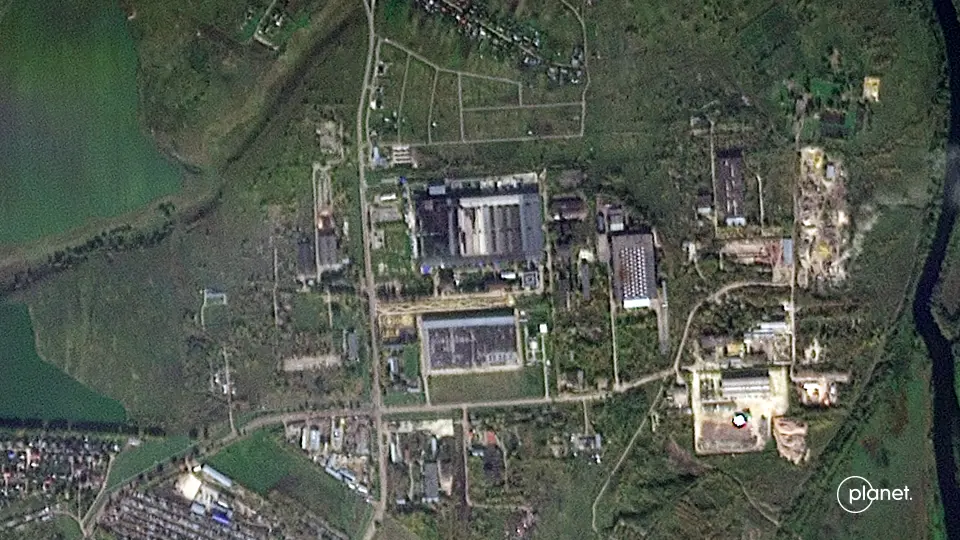
Ukrainian drone strikes have knocked out two of the five data centers operated by Yandex, the Russian technology giant often described as Russia's Google. The damage has left the company scrambling to maintain its AI chatbot and other online services, according to reports, in one of the most direct attacks yet on the digital infrastructure underpinning Russia's consumer internet.
The strikes hit Yandex facilities in the Sasovo and Kaluga regions on October 8 and October 9. They came as a direct response to a Russian drone campaign against Ukraine's data centers, which has disrupted mobile phone and internet services for thousands of Ukrainians since late September.
Ukrainian President Volodymyr Zelenskyy said in a post on X: &8220;We continue to respond to Russia&8217;s attacks on Ukraine, and we&8217;re doing so with high precision. Another data center was hit as well&8212;our symmetrical response.&8221;
Key facts at a glance
- Ukrainian drone strikes damaged two of Yandex's five data centers.
- The affected facilities were in Sasovo and Kaluga, Russia.
- The strikes occurred on October 8 and October 9.
- Ukraine described the operation as a symmetrical response to Russian attacks on Ukrainian data centers.
- Yandex said no employees were hurt but acknowledged disruptions to some services.
- The Sasovo facility housed two of the company's three supercomputers used to train its YandexGPT AI model.
- The Kaluga data center is Yandex's largest such facility, and Ukrainian company Firepoint said its FP-1 one-way attack drones were involved in that strike.
- Russian users reported problems with media sites, streaming, banking, railways, dating, real estate, publishing and sports websites.
A direct hit on Russia's digital backbone
Yandex is far more than a search engine. Over two decades, it has built an ecosystem that spans search, maps, email, cloud services, advertising, ride-hailing, food delivery, streaming, fintech and artificial intelligence. Its search engine remains the most popular in Russia, and its services are woven into daily life for millions of people. That makes its data centers strategic assets, not merely commercial facilities.
The strike on the Sasovo data center is especially significant because the site houses two of the three supercomputers Yandex uses to train YandexGPT, the company's large language model. AI training clusters are power-hungry, highly specialized and difficult to replace quickly. Even if backup systems and redundant capacity exist, losing access to a substantial share of training compute can slow model development, disrupt inference workloads and force engineers to shift resources to keep consumer services online.
The Kaluga facility, described as Yandex's largest data center, would be equally important for cloud storage, content delivery and platform operations. The involvement of FP-1 one-way attack drones, according to the Ukrainian manufacturer Firepoint, underscores how long-range strike drones are being used against fixed infrastructure far from the front line. The weapons are relatively inexpensive compared with missiles, but they can still cause serious damage when they hit critical nodes in a network.
Yandex said no employees were injured. The company acknowledged that some services had been disrupted, a measured statement that likely understates the operational pressure created by losing two major facilities in quick succession. For a platform business, even brief outages can ripple across advertising revenue, merchant transactions, media streaming and cloud customers.
Disruptions across the Russian internet
The effects were visible to ordinary users. Russian internet users reported problems accessing media websites and popular apps, including the Ivi video streaming platform, the digital banking service T-Bank and the state-owned Russian Railways. Other impacted services included a dating app, a real estate aggregator, a self-publishing book platform and the website of the most successful professional soccer club in the Russian Premier League.
Those failures illustrate how deeply data centers shape the modern economy. Banking apps depend on always-on cloud infrastructure. Streaming platforms rely on content delivery networks and storage clusters. Railways need reservation systems and logistics software. Even a soccer club's website may sit behind the same commercial hosting and content distribution systems that serve much larger platforms. When core facilities are damaged, the outage can appear in unexpected places, from ticket sales to match updates.
The list of affected services also shows that the strikes did not need to destroy every Yandex facility to have an effect. By hitting two key sites, the drones created uncertainty about capacity, forced traffic to reroute and raised questions about how much redundancy remains. Data centers are designed with backups, generators, cooling systems and network paths, but they are not invulnerable. Physical damage to power distribution, cooling or networking equipment can take time to repair, especially under sanctions and wartime constraints.
A retaliatory campaign
Ukraine framed the strikes as a response to Russian attacks on its own data infrastructure. Since late September, Russian drone strikes have targeted Ukrainian data centers, disrupting mobile phone and internet services for thousands of people. Those attacks fit a broader pattern of Russian strikes against power grids, transportation hubs and residential buildings since the full-scale invasion began in February 2022.
Ukraine has recently faced a shortage of interceptor weapons capable of shooting down Russian missiles and jet-powered drones. That constraint has pushed Kyiv to rely more heavily on its own medium-range and long-range drone strike campaign. Ukrainian drones have focused on Russian military bases and supply lines, Russian-linked shipping in the Sea of Azov and the Black Sea, and Russian energy infrastructure such as oil refineries.
In the summer of 2026, Ukraine also targeted multiple warehouses belonging to Wildberries and Ozon, the Russian e-commerce companies often compared to Amazon. Those strikes signaled a willingness to hit commercial logistics and digital-commerce infrastructure that supports the Russian economy. The Yandex data center strikes extend that logic to cloud computing and AI, sectors that are increasingly central to modern economic and military power.
Data centers as wartime targets in 2026
The Yandex operation is part of a wider shift: data centers are becoming wartime targets. In February 2026, after the United States and Israel attacked Iran, Iranian drones knocked out multiple Amazon data centers in Bahrain and the United Arab Emirates. That episode demonstrated how quickly cloud infrastructure can become a front line in a regional conflict.
Data centers are attractive targets because they concentrate value. A single facility can host thousands of servers, store sensitive data, run AI models, support financial transactions and coordinate logistics. Damaging one can produce effects far beyond its physical footprint. Unlike a bridge or a factory, a data center may not look like a traditional military target, but its role in communications, commerce and government services makes it strategically significant.
The attacks also raise difficult questions about deterrence and defense. Data centers are often located in remote areas for power and cooling reasons, which can make them harder to protect with traditional air defenses. Defenders must guard against drones, missiles, sabotage and cyber operations. Operators must build redundancy across regions, but redundancy becomes less effective when an adversary can strike multiple sites in a short period.
For Yandex, the challenge is compounded by its role as a national platform. The company must keep search, maps, email, payments and media services running while also pursuing AI ambitions. Large language models require massive computing clusters, reliable power and specialized cooling. If training capacity is disrupted, the company may need to prioritize inference for consumer products over research and development. That trade-off could affect its competitive position over time.
The wider war and the Black Sea
The strikes come amid signs that the conflict is widening beyond the immediate battlefield. On October 5 and October 6, coordinated aerial and sea drone strikes sank two commercial ships in the Black Sea within the exclusive economic zones of NATO members Romania and Bulgaria. Ukrainian President Zelenskyy attributed those attacks to Russia.
Those incidents, together with the data center strikes, show how drones are reshaping the geography of the war. Ukraine is using long-range drones to reach deep into Russia, while Russia is using drones and missiles to pressure Ukraine's infrastructure. Commercial ships, refineries, warehouses and data centers are all part of a broader contest over the systems that sustain modern economies and militaries.
The Yandex strikes also highlight the vulnerability of AI infrastructure in wartime. Supercomputers and data centers are expensive, conspicuous and difficult to relocate quickly. Even with cloud backups and distributed architecture, the loss of key facilities can slow development, disrupt services and force companies to make hard choices about which workloads to protect. For a company that positions itself as Russia's leading AI developer, the damage is both operational and symbolic.
As drone technology improves and long-range attacks become more common, the line between civilian infrastructure and strategic asset is likely to blur further. The strikes on Yandex's data centers show that the digital backbone of a country can be targeted directly, with consequences that reach from AI research labs to banking apps, streaming platforms and railway ticketing systems.
Source:Ars Technica News