

Artificial intelligence is no longer a distant experiment for urban leaders. Across the world, cities are moving AI from controlled pilots into everyday operations, where it is expected to improve everything from traffic flow and waste collection to public safety and energy management. The shift is being driven by a convergence of technologies: edge computing, computer vision, unified data platforms, agentic AI, and secure digital foundations. Together, these tools promise to help cities turn growing volumes of urban data into smarter, faster decisions and more responsive services.
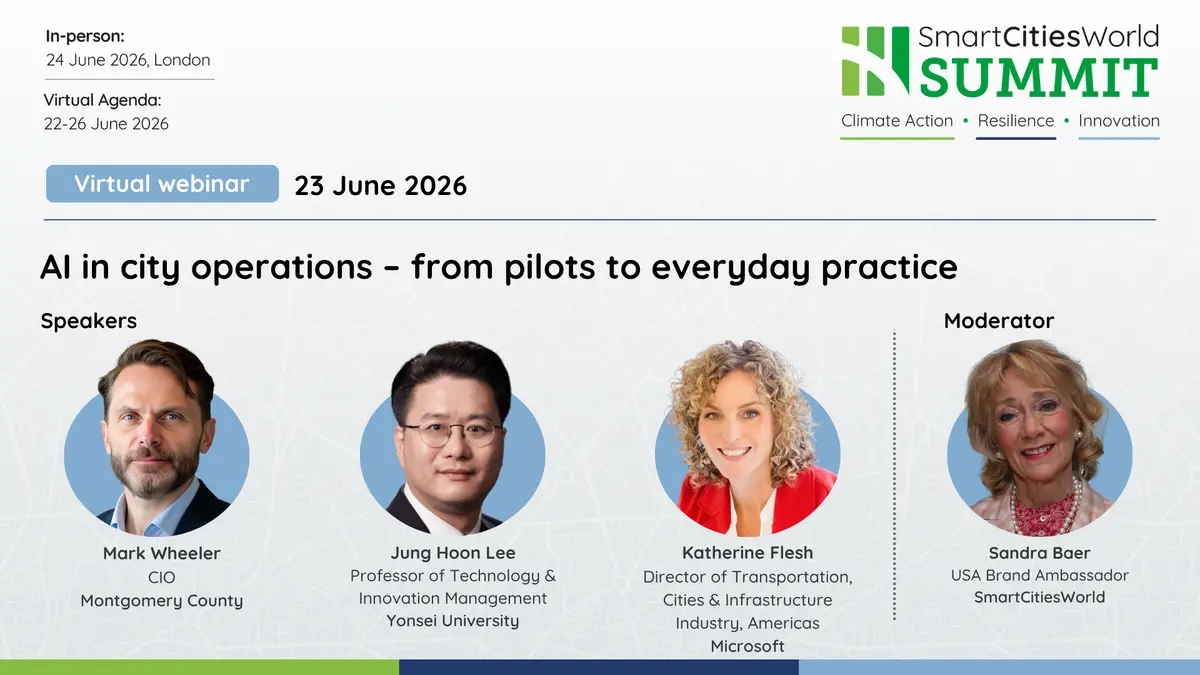
A new on-demand panel discussion brings together urban leaders and technology partners to examine what it takes to scale AI in city operations. The conversation focuses on practical pathways for local authorities, including how to strengthen workforce decision-making by combining unified data, agentic AI, and secure digital foundations. Rather than treating AI as a standalone novelty, the panel frames it as an operational layer that can support staff, optimise resources, and improve resident outcomes.
Key facts: AI moves from pilots to practice
- AI, edge computing and computer vision can help cities turn growing volumes of urban data into smarter, faster decisions and more responsive services.
- Local authorities can strengthen workforce decision-making by combining unified data, agentic AI and secure digital foundations.
- A major 2026 urban innovation summit will bring together city leaders and partners during London Climate Action Week to explore how climate change, infrastructure resilience and digital transformation intersect.
- Malaysia is leading AI-powered urban innovation at the first Southeast Asian Smart City Expo in Kuala Lumpur.
- Singapore is further building its reputation as one of the smartest nations in the world in the latest city profile.
- Sunderland is repositioning itself as a leading smart city using digital infrastructure and low-carbon innovation to build a resilient, future-focused economy.
- Professor Jung Hoon Lee explores how AI is moving from pilots to real-world impact, the latest Global Smart City Index, and the emerging AI super gap between cities.
- Smart sensor networks can improve indoor safety by detecting risks early, improving situational awareness and supporting healthier, more secure and sustainable buildings.
- Gareth Tang, President of Urban Solutions at ST Engineering, explains how urban AI applications are set to evolve and details projects where AI is already making significant impact.
- Panel discussions include Cities and the energy transition – from consumers to system leaders; and Unlocking value in cities from buildings, data and AI.
- Editorial newsletters are available daily and weekly, featuring news, city interviews, special reports and guest opinions.
Why AI is moving into everyday city operations
Cities have spent years testing AI in sandboxes. Pilots have demonstrated potential in areas such as adaptive traffic signals, predictive maintenance for water networks, automated waste sorting, and computer vision for public space management. But scaling those experiments requires more than algorithms. It demands reliable data pipelines, edge computing infrastructure that can process information close to the source, and governance frameworks that protect privacy and build public trust.
Edge computing is especially important for city operations because many decisions must be made in milliseconds. A camera at a busy intersection cannot wait for data to travel to a distant cloud and back. By processing video and sensor data locally, edge systems can detect accidents, pedestrian crowding, or traffic anomalies in real time. Computer vision then translates raw pixels into actionable events: a blocked lane, a fallen tree, an overflowing bin, or a safety hazard.
Yet the real value emerges when these technologies are connected to unified data platforms. When transport, waste, energy, and public safety teams work from a shared view of the city, AI can help prioritise incidents, allocate crews, and coordinate responses. Agentic AI takes this further by orchestrating multi-step workflows. Instead of simply flagging a problem, an agentic system might open a work order, dispatch the nearest available team, notify affected residents, and update dashboards. Human staff remain in control, but the AI handles routine coordination.
Secure digital foundations are the third pillar. Cities handle sensitive information about residents, infrastructure, and emergencies. AI systems must be designed with cybersecurity, data minimisation, and accountability from the start. Without that foundation, pilots may succeed technically but fail to earn the trust needed for everyday practice.
From pilots to practice: the role of governance and workforce
The transition from pilot to practice is often cultural as much as technological. City employees need training to work alongside AI, interpret its outputs, and override it when necessary. Procurement rules must accommodate iterative development rather than one-off purchases. Data sharing agreements must clarify ownership and liability. And elected officials need to explain to residents how AI is being used, what safeguards are in place, and how decisions can be appealed.
Professor Jung Hoon Lee has studied this shift closely. In a podcast conversation, he discusses the latest Global Smart City Index and the emerging AI super gap between cities. Some cities are rapidly building data platforms, AI-ready infrastructure, and effective governance, while others risk falling behind. The gap is not only about funding. It is also about institutional capacity, political will, and the ability to attract talent. Professor Lee argues that the next phase of urban innovation depends on these foundations, not just on deploying the latest model.
The AI super gap has implications for equity. If only wealthy cities can afford advanced AI, disparities in services, resilience, and economic opportunity may widen. To avoid that, cities need interoperable standards, shared learning, and financing models that support smaller municipalities. The panel discussion likely touches on these concerns, because AI in city operations is not just a technical upgrade. It is a governance choice about who benefits and how decisions are made.
City leadership: Malaysia, Singapore, and Sunderland
Several cities and regions are already demonstrating what practical AI leadership looks like. Malaysia is positioning itself as a leader in AI-powered urban innovation. The first Southeast Asian Smart City Expo in Kuala Lumpur is expected to showcase how AI, Internet of Things sensors, and digital twins can improve urban services. The event will bring together government agencies, startups, and multinational technology providers to explore solutions for mobility, energy, public safety, and sustainability.
Singapore continues to build its reputation as one of the smartest nations in the world. Its approach combines a strong digital government, comprehensive sensor networks, and open data platforms. City managers use AI for traffic prediction, water management, and estate maintenance. Singapore has also invested in digital twins that simulate urban developments before they are built, helping planners test scenarios for energy use, wind flow, and population density.
Sunderland offers a different but equally instructive example. The city is repositioning itself as a leading smart city by using digital infrastructure and low-carbon innovation to build a resilient, future-focused economy. Its strategy includes smart energy grids, retrofitting programmes, and digital skills training. By linking AI to decarbonisation, Sunderland shows how urban technology can serve both economic and climate goals.
These examples share a common thread: AI is not deployed for its own sake. It is embedded in wider strategies for economic development, climate action, and public service improvement. That is the difference between a pilot and everyday practice.
Smart sensors and safer buildings
Beyond outdoor city operations, AI and sensor networks are transforming indoor environments. Smart sensor networks can improve indoor safety by detecting risks early, improving situational awareness, and supporting healthier, more secure, and sustainable buildings. In offices, hospitals, schools, and transport hubs, sensors monitor air quality, temperature, occupancy, and equipment performance. AI analyses the data to identify anomalies that might indicate a fire risk, a gas leak, or a failing ventilation system.
Early detection saves lives and reduces downtime. For example, a sensor that detects a slight increase in carbon monoxide can trigger ventilation and alert facilities staff before anyone is harmed. Computer vision can identify blocked fire exits or unsafe crowding. And by optimising heating, cooling, and lighting based on real-time occupancy, smart buildings cut energy use and carbon emissions. These capabilities are becoming essential as cities face more extreme weather and higher expectations for indoor health.
The same sensor networks also support maintenance. Instead of fixed schedules, facilities teams can repair equipment when data indicates it is needed. That extends asset life, reduces waste, and keeps buildings operational during critical periods. For city authorities that manage large property portfolios, the savings can be substantial.
Urban AI applications evolve
Gareth Tang, President of Urban Solutions at ST Engineering, explains how urban AI applications are set to evolve. In his view, the next wave will move beyond isolated use cases toward integrated platforms that connect transport, security, and environmental systems. He details projects where AI is already making a significant impact, such as video analytics for incident detection, AI-assisted command centres, and predictive models for infrastructure maintenance.
According to Tang, the key is to design AI as a decision-support tool rather than an autonomous authority. City staff need to understand why an AI system made a recommendation, what data it used, and how confident it is. Explainability and human oversight are therefore not optional extras. They are requirements for adoption at scale.
He also emphasises the importance of public-private partnerships. Cities often lack the in-house expertise to build and maintain advanced AI systems. By working with technology providers, they can access specialised skills while retaining control over policy, data governance, and service standards. The challenge is to structure contracts so that innovation continues after the initial deployment.
Energy transition and the value of buildings, data, and AI
The broader program includes a panel discussion titled Cities and the energy transition – from consumers to system leaders. This reflects a major shift in how cities view their role in energy. Historically, cities were consumers of electricity and gas. Now, many are becoming system leaders by integrating renewable generation, storage, electric vehicle charging, and demand response. AI helps balance these complex systems by forecasting demand, managing distributed energy resources, and coordinating with grid operators.
Another panel, Unlocking value in cities from buildings, data and AI, explores how real estate and urban data can be combined to improve services and generate economic value. Buildings are not just physical assets. They are data sources. When connected to city platforms, building management systems can contribute to grid stability, emergency response, and climate reporting. AI can uncover patterns that reduce costs and emissions while improving occupant comfort.
Together, these discussions show that AI in city operations is not a single project. It is an ecosystem play. It requires data standards, cybersecurity, workforce development, and long-term partnerships. The cities that succeed will be those that treat AI as part of their operating model, not as a one-off experiment.
What local authorities should consider
For local authorities at the beginning of their AI journey, several practical steps stand out. First, start with a problem, not a technology. Identify a service challenge where better data and faster decisions would make a measurable difference. Second, build a data foundation. Clean, interoperable, well-governed data is more important than the most advanced algorithm. Third, invest in edge and cloud infrastructure that can support real-time and large-scale processing. Fourth, establish ethical and legal guardrails early. Fifth, train staff and communicate with residents.
Finally, measure outcomes. Pilots often succeed because they are small and controlled. Scaling requires evidence that AI improves service quality, reduces costs, or enhances safety. That evidence must include not only technical metrics but also public trust and equity. When cities can demonstrate those outcomes, AI moves from a promising pilot to everyday practice.
The panel discussion on AI in city operations is available on demand, alongside other sessions on energy transition and unlocking value from buildings, data, and AI. Editorial newsletters provide daily and weekly roundups of news, city interviews, special reports, and guest opinions for urban leaders following these developments.
Source:Smart Cities World News