

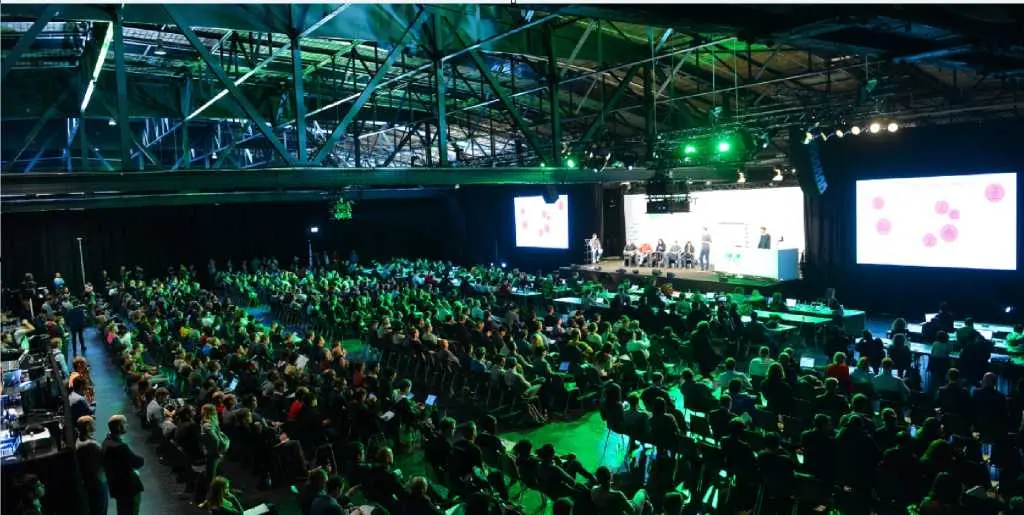
In just four days, a major technology conference will open its doors in San Francisco, bringing together startup founders, investors, AI researchers, software engineers, and technology builders from around the world. The event, scheduled for October 13–15 at Moscone West Convention Center, will focus on the next wave of artificial intelligence and its impact on software development. With more than 200 sessions across six stages and over 250 technology leaders, the conference aims to map the future of AI agents, generative AI, developer tools, enterprise software, and information security.
The timing is significant. Artificial intelligence has already transformed how software is written. First came code completion tools that predicted the next line, function, or boilerplate based on what a developer had already typed. Then came code suggestions and code generation, where AI could write new code or improve existing code from a natural language prompt. Today, coding agents can inspect a codebase, suggest improvements, compile and test the improved code, and iterate toward something better, faster, and safer. They can plan, write, test, review, and debug code, and they can discuss all of these tasks with a human developer. Increasingly, they can tackle complex development workflows entirely on their own.
From Autocomplete to Autonomous Agents
The journey from simple autocomplete to autonomous coding agents has been remarkably fast. Early tools relied on statistical language models and pattern matching. Developers saw them as helpful but limited. They could finish a line of code, but they could not understand intent or context. The arrival of large language models changed that. Models trained on vast repositories of public code learned to generate syntactically correct functions, suggest API calls, and even explain what a piece of code does.
Next, AI assistants became conversational. A developer could ask for a function that parses a CSV file, and the model would produce a working draft. The assistant could refactor a messy method, add error handling, or translate code from one language to another. These tools reduced boilerplate and accelerated prototyping. But they still required a human to copy, paste, review, and test the output.
Now, coding agents represent a step change. An agent is not just a model that responds to a prompt. It is a system that can take a goal, break it into steps, use tools, and act. It can read files, search a codebase, run tests, inspect error messages, and modify code. It can open a pull request, respond to review comments, and update documentation. Some agents can even coordinate with other agents, dividing work across specialized roles such as planner, coder, tester, and reviewer.
This shift raises important questions. If agents can write and test code, what is the developer’s role? How do teams ensure quality, security, and maintainability? What happens to junior developers who traditionally learned by doing the tasks that agents now handle? These are exactly the questions that the upcoming conference is designed to explore.
What the Conference Will Cover
Over three days, attendees will hear from technology leaders across Amazon, Anthropic, Atlassian, Databricks, Flock, Glean, Google, NVIDIA, Okta, OpenAI, Replit, Runware, Together AI, and other companies at the cutting edge of AI and software. The sessions will examine how AI agents and generative AI are changing software engineering, developer tools, enterprise software, and information security. They will also look at how AI is reshaping SaaS and cloud infrastructure, how companies are building and deploying AI systems, and how AI is driving innovation in finance, healthcare, manufacturing, and other industries.
One highlight will be a session from Anthropic, the company behind Claude Code, on how the firm uses fleets of coding agents in its own software engineering work. Technical staff members Steve Androulakis and Sachin Malhotra will share practical patterns for delegating agents, reviewing their output, and recovering when they get things wrong. This is a rare look inside a leading AI company’s development process, and it promises to be valuable for teams considering their own agent workflows.
Other sessions will likely address the economics of AI-assisted development. If a single engineer can supervise multiple agents, teams may need fewer people to ship the same amount of code. But they may also need more senior engineers who can design systems, define constraints, and review agent output. The net effect on jobs is still uncertain. Some experts predict a productivity boom that expands what small teams can build. Others warn of disruption for entry-level roles and routine coding tasks.
The Technical and Ethical Challenges
Coding agents are powerful, but they are not magic. They can hallucinate APIs, introduce subtle bugs, or produce code that passes tests but violates security best practices. They may struggle with large, legacy codebases that lack documentation or consistent patterns. They can also be expensive to run, especially when they use multiple models, tools, and iterations.
Security is a major concern. An agent that can read and write files, execute commands, and access external services is a potential attack surface. If an agent is compromised or misconfigured, it could leak secrets, delete data, or introduce vulnerabilities. Organizations adopting agents will need robust guardrails: sandboxed execution, permission controls, audit logs, and human review for sensitive changes.
Intellectual property is another issue. Models trained on public code may reproduce snippets that are subject to licenses. Companies need policies for scanning AI-generated code, attributing sources, and avoiding legal risk. The conference will likely touch on these topics, as they are central to enterprise adoption.
There is also the question of skill development. If agents handle the routine parts of coding, how do new developers learn? Some propose that juniors will spend more time reviewing, testing, and designing, while agents handle implementation. Others argue that juniors should still write code manually to build mental models. The answer may vary by team and domain.
What’s Next for AI and Software Development
Looking ahead, several trends are clear. First, agents will become more capable and more specialized. We will see agents for frontend development, backend services, data pipelines, infrastructure-as-code, security auditing, and compliance. They will integrate with IDEs, version control systems, CI/CD pipelines, and issue trackers. They will become part of the software supply chain.
Second, human-AI collaboration will become a core skill. Developers will need to write clear specifications, decompose problems, define success criteria, and evaluate agent output. They will act as tech leads for a team of AI workers. This requires strong communication, system design, and debugging skills, not just coding speed.
Third, governance and observability will mature. Teams will need to track which code was written by which agent, under what prompt, and with what review. They will need to measure quality, security, and cost. Tools for AI observability, prompt management, and agent orchestration are already emerging, and they will become standard in enterprise stacks.
Fourth, the definition of a “developer tool” will expand. Today, a developer tool might be an IDE, a linter, or a debugger. Tomorrow, it may be an agent platform that manages fleets of AI workers, or a marketplace for reusable agent skills. The conference’s six stages and 250 speakers will explore these possibilities from multiple angles.
Networking and Career Opportunities
Beyond the sessions, the event offers a chance to connect with peers, exchange ideas, and explore the latest innovations. Founders can meet investors. Engineers can meet hiring managers. Researchers can meet practitioners. The hallway track—the informal conversations between sessions—is often where the most valuable connections are made.
For those considering a career shift, the conference will provide insight into which skills are in demand. AI engineering, prompt engineering, agent operations, and AI security are emerging roles. Traditional software engineering is not disappearing, but it is evolving. Developers who understand how to work with AI agents will have an advantage.
Attendee, Founder, and Investor passes are available, and a limited-time discount is offered for eligible registrations. Those interested in learning what’s next for AI and software development should consider attending. The event runs October 13–15 at Moscone West Convention Center in San Francisco.
As the conference approaches, one thing is certain: the conversation around AI and software development is no longer about whether AI will change the field, but how quickly and how deeply. Coding agents are already writing, testing, and reviewing code in production environments. The next four days will bring together the people who are building that future—and the developers who will work alongside it.
Source:InfoWorld News