
Walking into a flagship startup conference in San Francisco, the plan was simple enough: find the AI companies, ask their founders how they feel about the public mood, and see whether the anxiety that dominates headlines has actually reached the people building the products. The premise sounds absurd on its face — this is a city where artificial intelligence is not a sector but the ambient weather.
San Francisco has become the undisputed capital of the AI boom. Two of the most valuable model developers in the world are headquartered downtown. Billboards selling agentic software line the freeways. Newly minted AI wealth is pushing housing costs higher. Post-pandemic office towers that sat empty for years are filling up with machine-learning startups. And for everyone who is not adjacent to the industry, the city hosts roughly a hundred simultaneous conversations about how AI is reshaping hiring, digital security, classrooms, dating, nightlife, the definition of reality, and the question of whether an investment bubble will take the wider economy down with it.
That was the backdrop for a reconnaissance mission across the conference floor. The goal was not to catalog every model release or funding round, but to meet founders face to face and see how — or whether — they were applying lessons from negative coverage and growing public unease. What emerged was a split screen: a floor full of builders quietly obsessed with safety and practicality, and a main stage where the biggest names mostly shrugged.
Family logistics, handled by agents
The first conversation of the day belonged to Anne Marie Joel, founder of a platform called KidSync, which describes itself as the place “where kid logistics get done.” Over a wildly overpriced sandwich, Joel laid out the problem her company attacks: working parents who need to keep a career on track while making sure their children are safe and enriched after the school bell rings.
“Involved kids stay on track, uninvolved kids stay home by themselves,” she said. “Bringing more kids into activities and keeping parents at work is what helps them keep their jobs.” For the technically minded, she framed KidSync as material requirements planning for family life — the same scheduling logic manufacturers use to manage inventory and production, applied to summer camps, registration deadlines and carpools.
The pitch raises an obvious question: will parents trust an agentic system with their children's whereabouts? Joel's answer leaned hard on compliance, noting the platform launches with protections for children's data, with school-information and medical-privacy certifications to follow. The acronyms may not land with every parent, but the instinct — lead with data safety rather than dazzle — was a recurring pattern among the founders on the floor.
Whisper-level dictation
Next up was Tyler Chen, co-founder of a hardware startup called Subtle, demonstrating a pair of earpieces branded Voicebuds. The devices are designed for extremely low-volume voice capture: they pick up near-inaudible whispers and convert them into text for whatever assistant or model the wearer prefers.
In a live demo amid the roar of the conference hall, the transcription accuracy was genuinely startling. Chen described using the buds to talk to a chatbot discreetly on a crowded bus, or to dictate code while sitting in a shared office without disturbing anyone nearby. The technical explanation was elegant in its simplicity: whispering does not vibrate the vocal cords, so the system listens instead for cues of friction in the throat and mouth.
Whether that demo holds up under prolonged real-world testing remains to be seen. But as a data point about the current moment, Voicebuds captures the duality perfectly. Discreet dictation is obviously useful. It also means an entire room of strangers can now talk to machines without anyone knowing.
The mood board behind the reporting
Any honest assessment of AI sentiment has to account for the observer's own priors. On the “AI is useful” side of the ledger: dozens of daily queries to chatbots for research and factual digging, regular help building editorial publishing schedules, grammar and translation tools, interview transcription and summarization. There is also genuine enthusiasm for AI-accelerated work in medicine and the sciences, where the payoff is measured in years of researcher time rather than clicks.
On the other side sits a growing pile of concerns. Data centers and their insatiable appetite for power and water. Deepfakes. Automated accounts flooding social platforms. Agents that impersonate job candidates. The intersection of autonomous assistants and phishing scams. Prominent investors and researchers who have spent the past two years firing flare guns about an impending bubble and, in some cases, about existential risk.
Closer to home, a sibling who teaches English in the city now assigns essays in pen and paper to keep students from outsourcing them. And the author's own job has grown harder, not easier, as organizations adopt AI to generate useful data — because AI is extraordinarily good at producing oceans of data, and every one of those oceans needs a human to review and prioritize it. That human is often the person who asked for it.
So do the founders on the floor share those concerns? The answers were more nuanced than the stage suggested.
An AI big sister, and a wearable that listens
Among the kiosks, plenty of companies had nothing to do with AI at all, but the ones that did ranged from the curious to the disarming. One outfit promised the digitalization of smell, using sensor arrays to mimic the human nose for quality-checking seafood and measuring odor emissions on factory floors — absurd at first blush, then quietly compelling.
Another, HotGirlHotline.ai, bills itself as an AI big sister that young women turn to for advice. Co-founder Sumi Mudgil argued that the cultural icons women already consult — glossy magazines, confessional podcasts, influencers — have always delivered guidance one-to-many, and that AI can finally personalize it. She was careful to distinguish the product from an “AI companion,” describing a chatbot fine-tuned on open-source and foundation models for elements of cognitive behavioral therapy and built with heavy guardrails, asking Socratic questions rather than dispensing verdicts.
Privacy surfaced again on the main stage, when Amazon's devices chief Panos Panay discussed a new ambient AI wearable that turns conversations into searchable summaries. “You have to design with privacy in mind,” he said, calling it critical. What went unaddressed was the consent problem inherent to any always-listening device: it can capture the conversations of strangers at the next table, and the burden of asking permission falls on the wearer.
Mosquitoes, robots and public safety
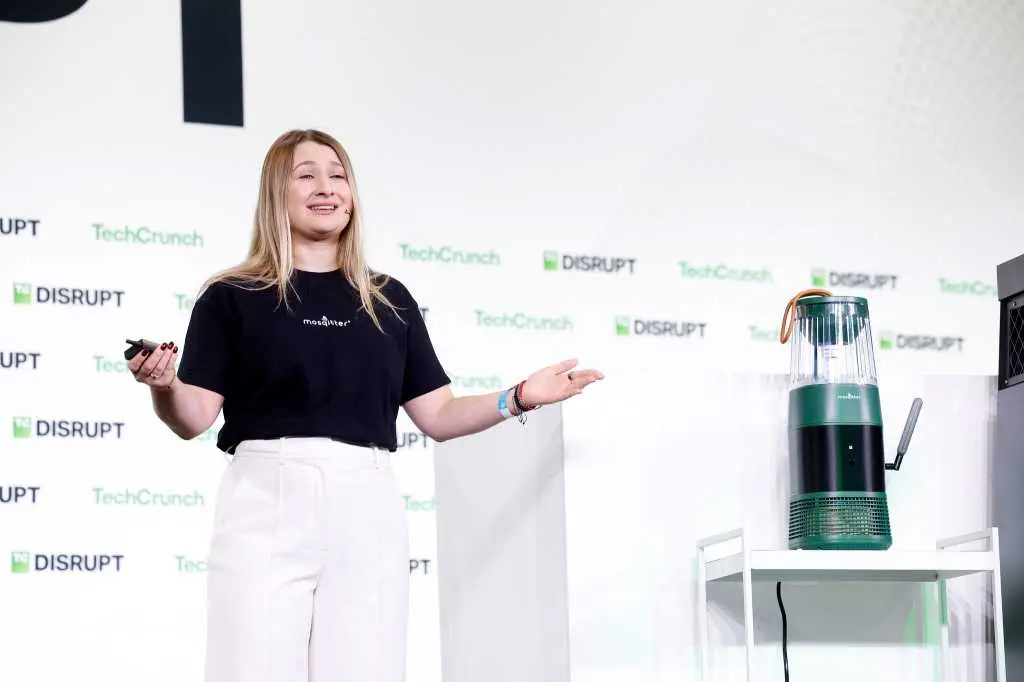
Two hardware startups stood out precisely because their AI serves an unglamorous public good. Mosqitter, a finalist in a conference startup competition, builds an obelisk-shaped trap that emits heat, scent and light to lure biting female mosquitoes. Machine vision then identifies the species of each captive, feeding a global monitoring system that maps where disease-carrying insects are moving.
Co-founder Anastasiia Romanova pointed out that different species carry different threats — malaria, Zika, dengue — and that governments currently lack granular data on which mosquitoes are where. Field-deployed sensors, she argued, would tell public health agencies when and where to intervene. A consumer version sells for around $200; the networked model is aimed at institutions.
Roughly a hundred feet away sat SpaceTime Industries, which proposes stationing shipping containers full of robots near vulnerable infrastructure — remote power plants, water systems, facilities exposed to natural disasters or sabotage. Founder Honorebel S. Walker described up to fifteen drone and wheeled sentries operating autonomously, feeding imagery and sensor data into a command-and-control software layer so human operators can make better decisions. “When environments become dangerous, you need robotics to move first so that humans don't have to,” he said. The team has completed a software pilot and aims to fabricate a container by January for a solar partner. No robots carry weapons, and the posture is defensive — though any story about autonomous machines patrolling critical infrastructure inevitably invites science-fiction comparisons.
The stage versus the floor
The contrast with the main stage was stark. There, the chief executive of an AI chipmaker joked that some industry leaders should not be allowed to speak in public, dismissing doomsday warnings out of hand. The head of an electric-vehicle maker rhapsodized about agents integrating with cabin software, calling the result magical, while insisting they would never touch the brakes. And a Hollywood actor endorsed scanning technology that would let studios drop digital likenesses of today's performers into tomorrow's films, musing that his grandchildren could manage his image and, with luck, put him in good movies.
Down on the floor, the mood was different. The founders working the kiosks are not the people building frontier models; they are closer to craftspeople, taking raw materials they did not make and shaping them into specific products for specific customers. Many had traveled across the country to be there. Their pitches occasionally drifted into jargon, but the emphasis on safety, compliance and concrete results was consistent — and notably free of grand talk about agents everywhere.
One detail stood out: nearly every founder interviewed was a woman. That may reflect the particular booths that drew attention, or it may say something about who is building the practical layer of the AI economy while the biggest platforms consolidate above them. None of these companies will be putting billboards downtown, because their customers do not work downtown.
Follow-up questions after the conference, asking founders to react to specific public anxieties — data center backlash, deepfake harassment, warnings of catastrophic risk — produced earnest but anodyne answers that circled back to product safety. No one conceded the depth of public concern.
The most reassuring conversation may have been the least ambitious. Justin Scott, founder of Sit Sense, makes an automated medical recliner that repositions patients to prevent pressure injuries and improve circulation. Asked to describe his AI angle, he did not reach for one. “We actually don't have an AI angle right now,” he said. “We have a solution, and we don't need to overcomplicate the solution by adding AI.”
Source:PCWorld News